If you’re a school-based speech-language pathologist, you know that finding engaging speech therapy games for mixed groups can sometimes feel like a challenge. One student is working on articulation, another needs support with expressive language, and someone else is targeting executive functioning skills. How do you keep everyone engaged while making sure each student gets meaningful practice?
After more than 20 years as a speech-language pathologist, I’ve learned that some of the best therapy activities aren’t necessarily designed for speech therapy at all. They’re everyday games that can be adapted to target multiple goals without requiring hours of preparation.
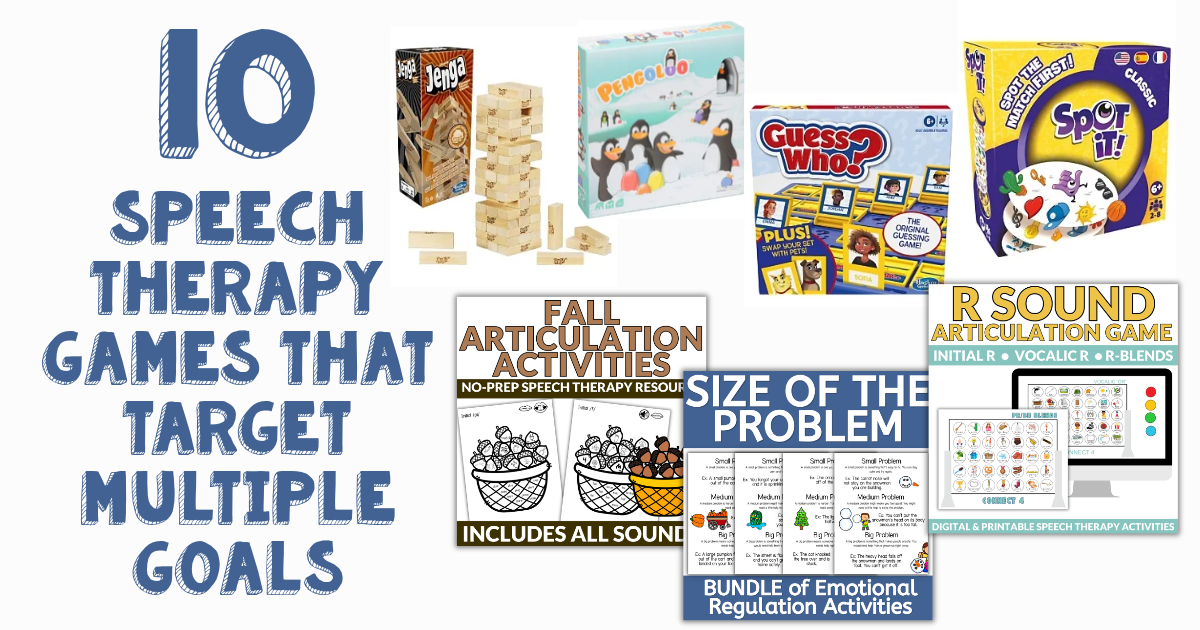
In this post, I’m sharing 10 of my favorite speech therapy games that I actually use with students. From familiar favorites like Guess Who? and UNO to games like Pengoloo and Honeybee Tree, I’ll show you practical ways to target articulation, vocabulary, describing, following directions, problem-solving, and more.
Whether you’re planning for a mixed group or simply looking for fresh ways to keep students motivated, these games can help you make the most of your therapy time.
This post contains affiliate links. As an Amazon Associate I earn from qualifying purchases.
1. Guess Who? – Describing, Asking Questions, and Inferencing
Guess Who? is one of my favorite games for targeting multiple speech and language goals in a single session. While students are busy figuring out their opponent’s mystery character, they’re also practicing important communication skills.
Speech Therapy Skills You Can Target:
- Describing: Practice identifying and describing attributes such as hair color, clothing, facial features, and accessories.
- Asking Questions: Help students formulate clear yes/no questions instead of simply guessing characters.
- Categorization: Work on grouping characters by shared features and identifying similarities and differences.
- Inferencing: Encourage students to use the information they’ve gathered to eliminate possibilities and make logical guesses.
- Articulation: Have students practice target words or sentences before taking their turn.
Mixed Group Therapy Tip: Give each student a different communication goal during the same game. One student might practice producing /r/ in questions, another might formulate complete sentences, and a third might work on asking relevant questions and using clues to narrow down the possibilities.
Make It Easier: Provide sentence starters such as “Does your person have ___?” or “Is your person wearing ___?”
Make It Harder: Challenge students to ask more strategic questions, explain why they eliminated certain characters, or describe their mystery person using multiple attributes.
2. Sneaky Snacky Squirrel – Following Directions, Language, and Flexible Thinking
The Sneaky, Snacky Squirrel Game is a favorite for practicing speech and language skills while keeping little hands busy! Students use squirrel-shaped tweezers to collect colorful acorns, making it a fun option for younger students who benefit from hands-on activities. I also love that it requires NO reading, making it a perfect game for our younger learners.
What makes this game especially useful for speech therapy is how easily it can be adapted to target different goals without changing the basic gameplay.
Speech Therapy Skills You Can Target:
- Following Directions: Practice one-step and two-step directions using colors, actions, and sequencing. For example, “Pick up a red acorn, then put it in your log.”
- Vocabulary and Basic Concepts: Target color words, counting, and concepts such as in, out, more, less, and empty.
- Expressive Language: Encourage students to request colors, describe their acorns, and formulate complete sentences.
- Articulation: Have students practice their target sounds or words before collecting an acorn.
- Executive Functioning: Work on turn-taking, impulse control, flexible thinking, and managing disappointment when the spinner changes the game.
Mixed Group Therapy Tip: Give each student a different task before their turn. One student might follow a two-step direction, another might produce five articulation targets, and a third might describe their acorn using a complete sentence. Everyone participates in the same game while working toward individual goals.
Make It Easier: Use visual supports, model short phrases, or provide a choice of two colors. You can also simplify the spinner rules for students who need additional support.
Make It Harder: Add multistep directions, require students to explain their choices, or introduce a problem-solving question when an unexpected spinner result occurs.
One of my favorite things about using games like this in speech therapy is that students are practicing important communication and self-regulation skills while simply enjoying the game.
I often will play this game alongside my Acorn Articulation activity. Instead of coloring each acorn, we often use the acorns from the Sneaky Snacky Squirrel Game to cover each picture!

3. Jenga – Articulation, Language, and Problem-Solving
Jenga is one of those games I keep coming back to in speech therapy because it’s simple, engaging, and easy to adapt for almost any goal. Students take turns carefully removing wooden blocks from a tower and stacking them on top, all while trying to keep the tower from falling. The suspense alone is usually enough to keep everyone motivated!
Speech Therapy Skills You Can Target:
- Articulation: Have students practice a set number of target words, phrases, or sentences before removing a block. You can easily adjust the difficulty for each student.
- Expressive Language: Ask students to describe their choices, formulate sentences, or answer questions before taking their turn.
- Following Directions: Incorporate directions such as “Remove a block from the middle, then place it on top” or “Find a block below the top three rows.”
- Problem-Solving: Encourage students to think about which blocks are safe to remove and predict what might happen if they choose a particular block.
- Executive Functioning: Target planning, impulse control, flexible thinking, and emotional regulation as students carefully consider their moves and respond when the tower falls.
Mixed Group Therapy Tip: Keep a small stack of articulation cards, language prompts, or executive functioning questions nearby. Each student completes a task related to their individual goal before taking a turn. This keeps everyone engaged in the same game without needing separate activities.
Make It Easier: Build a shorter tower, offer choices between two blocks, or provide sentence starters and visual supports.
Make It Harder: Have students explain their strategy before moving a block, predict the outcome of their choice, or complete a more challenging speech or language task before each turn.
Bonus Tip: You don’t need to write on the blocks or attach anything to them! Keeping your Jenga set plain makes it easy to use with different students and therapy goals throughout the day.
4. Spot It! – Vocabulary, Word Retrieval, and Attention
Spot It! is a fast-paced matching game that works beautifully for speech therapy, especially when you only have a few minutes left in a session. Each pair of cards has one matching symbol, and students race to find and name it. The simple rules make it easy to introduce, while the variety of pictures provides plenty of opportunities to target different communication skills.
One of the things I love about Spot It! is that you can slow the game down or change the rules depending on your students’ needs. It doesn’t always have to be a race!
Speech Therapy Skills You Can Target:
- Vocabulary: Have students name the matching pictures, describe their attributes, or identify the categories they belong to.
- Word Retrieval: Encourage students to quickly name familiar objects. For students who need additional support, provide semantic or phonemic cues to help retrieve the word.
- Articulation: Have students practice the matching word or use it in a sentence when it contains their target sound. You can also incorporate separate articulation cards between turns.
- Expressive Language: Ask students to formulate sentences using the matching picture or explain how two pictured objects are alike or different.
- Attention and Visual Scanning: Encourage students to carefully scan both cards, maintain attention, and identify the matching symbol.
- Executive Functioning: Practice impulse control, flexible thinking, and emotional regulation, particularly when students need to wait, make a mistake, or lose a round.
Mixed Group Therapy Tip: Instead of having everyone race to identify the matching symbol, take turns. One student might name and describe the picture, another might use it in a complete sentence, and a third might practice an articulation target before taking the next turn. This allows students with different goals to participate without the pressure of competing against one another.
Make It Easier: Play cooperatively, remove the time pressure, and allow students extra time to scan the cards. Provide choices or verbal cues when needed.
Make It Harder: Challenge students to name the matching symbol and then describe it using three attributes, formulate a complex sentence, or identify another word in the same category.
Bonus Tip: For students working on self-regulation, try having everyone silently find the matching symbol before giving a signal to respond. It’s a simple way to practice waiting and impulse control while keeping the game engaging.
One thing I really love about Spot It! is that there are so many different options! If you know my family, we OF COURSE have the Disney version. We also have the Junior version from when my kids were younger. For older boys students that may be a little harder to engage, the NFL version is a favorite!
5. Connect 4 – Articulation, Planning, and Strategic Thinking
Connect 4 is a classic game that works well for speech therapy because it’s quick to set up, easy to learn, and engaging for a wide range of ages. Students take turns dropping colored discs into a vertical grid, trying to connect four of their own pieces in a row. While the rules are simple, the game creates plenty of opportunities to practice communication and executive functioning skills.
I especially like using Connect 4 with mixed groups because students can work on completely different goals without changing the game itself.
Speech Therapy Skills You Can Target:
- Articulation: Have students practice their target words, phrases, or sentences before dropping a disc into the grid. Adjust the number of repetitions or level of difficulty for each student.
- Following Directions: Incorporate spatial concepts and multistep directions, such as “Put your red disc in the column next to the yellow disc” or “Find the column on the far right, then drop your piece.”
- Expressive Language: Encourage students to explain their moves, describe the game board, or formulate complete sentences about their strategies.
- Problem-Solving: Ask students to identify possible moves, predict what their opponent might do next, and explain how they could block an opponent from connecting four.
- Planning and Organization: Encourage students to think ahead rather than choosing a column randomly.
- Impulse Control and Flexible Thinking: Practice waiting for turns, considering choices before acting, and adjusting plans when an opponent makes an unexpected move.
Mixed Group Therapy Tip: Use each turn as an opportunity to target an individual goal. One student might produce five articulation words, another might follow a spatial direction, and a third might explain their strategy using a complete sentence. Everyone stays involved in the same game while working on different skills.
Make It Easier: Play cooperatively, model possible moves, or use a smaller portion of the board to simplify choices. For students working on articulation, begin with single-word practice before increasing complexity.
Make It Harder: Challenge students to explain two possible moves and predict the outcome of each before choosing. You can also incorporate conditional directions, such as “If your opponent has three yellow discs in a row, find a way to block them before taking your turn.”
Bonus Tip: Try a “Think Before You Drop” rule! Before placing a disc, students pause, look at the board, and explain their plan. This adds a simple executive functioning component without requiring any additional materials.
I also created a Connect 4 Printable and Digital option specifically for singleton r, r-blends, and vocalic r! I wanted something that my students could use in therapy and then take home for additional practice.

6. Hedbanz – Describing, Categorization, and Asking Questions
Hedbanz is a fun guessing game that gets students asking questions, thinking critically, and using descriptive language without even realizing how much they’re practicing! Each player wears a headband with a picture card they can’t see. By asking questions and listening to clues, students try to figure out what’s on their card.
What makes Hedbanz especially useful for speech therapy is that students have to do more than simply name pictures. They need to think about categories, attributes, and the information they’ve already gathered to narrow down their guesses.
Speech Therapy Skills You Can Target:
- Asking Questions: Practice formulating relevant yes/no questions, such as “Am I an animal?” or “Can you find me in a kitchen?”
- Describing: Have students describe objects using attributes such as category, function, appearance, location, and parts.
- Categorization: Help students identify broad categories and narrow them down into more specific groups.
- Inferencing: Encourage students to combine clues, eliminate possibilities, and make logical guesses.
- Expressive Language: Practice complete sentences, sentence expansion, and explaining how clues support a guess.
- Executive Functioning: Target working memory, planning, flexible thinking, and self-monitoring as students remember previous answers and adjust their questions.
Mixed Group Therapy Tip: Assign different communication goals during the same round. One student might practice asking grammatically correct questions, another might provide clues using complete sentences, and a third might work on categorization or inferencing. Students working on articulation can practice their target sounds in questions or complete a separate set of target words before their turn.
Make It Easier: Provide visual question starters, category choices, or a simple describing chart. You can also allow students to give additional clues rather than limiting responses to yes or no.
Make It Harder: Challenge students to ask questions that eliminate multiple possibilities, remember previously answered questions, and explain why a particular guess makes sense.
Bonus Tip: Try a “No Guessing Yet!” rule. Students must ask at least three meaningful questions before guessing their picture. This encourages them to gather information, think strategically, and avoid impulsive guesses.
I recently made my own cards using free clipart and cardstock paper, and my 3rd and 4th graders loved it. The target words all contained vocalic r and they had SO many opportunities to practice their target sounds!
7. UNO – Following Directions, Flexible Thinking, and Emotional Regulation
UNO is a classic card game that can be used to target much more than matching colors and numbers! Between the Skip, Reverse, Draw Two, and Wild cards, students have plenty of opportunities to practice following directions, adapting to unexpected changes, and communicating with others.
One reason UNO works so well in speech therapy is that the game naturally creates situations where students need to think before acting, remember rules, and manage their reactions when things don’t go as planned.
Speech Therapy Skills You Can Target:
- Following Directions: Practice understanding and following game rules, including directions involving colors, numbers, and actions. Add verbal directions such as “Before you play a red card, name two things that are red.”
- Expressive Language: Encourage students to explain their choices, formulate complete sentences, and describe what’s happening during the game.
- Articulation: Have students practice a set number of target words, phrases, or sentences before playing a card. Adjust the difficulty for each student.
- Working Memory: Challenge students to remember whose turn comes next, track changes in direction, and recall the effects of special cards.
- Flexible Thinking: Practice adapting when someone changes the color, reverses the direction of play, or skips a turn.
- Emotional Regulation: Help students recognize feelings and practice appropriate responses when they have to draw additional cards, lose a turn, or don’t win.
Mixed Group Therapy Tip: Keep articulation cards, language prompts, or problem-solving scenarios nearby. Before playing a card, each student completes a task related to their individual goal. For students targeting executive functioning, use naturally occurring moments during the game to discuss flexible thinking, impulse control, and managing disappointment.
Make It Easier: Start with a smaller hand of cards, simplify the rules, or remove some of the action cards. Use visual reminders for students who need help remembering what each card means.
Make It Harder: Ask students to explain how a special card changes the game, predict what might happen next, or practice conditional directions such as “If you have a blue card, play it. If you don’t, choose a card that matches the number.”
Bonus Tip: Try a “Pause, Think, Play” strategy! Before each turn, have students stop, check the current color or number, and think about their options. This simple routine reinforces self-monitoring and impulse control without interrupting the fun.
8. Pengoloo – Working Memory, Following Directions, and Language Skills
Pengoloo is a fun memory game that gets students thinking, remembering, and communicating while they play! Colorful eggs are hidden beneath adorable penguins, and students roll dice to determine which colors they need to find. As they lift penguins and discover the hidden eggs, they have to remember where different colors are located.
What makes Pengoloo particularly useful for speech therapy is that students can practice language skills while strengthening their ability to remember and use information during gameplay. I also love that this game requires no reading!
Speech Therapy Skills You Can Target:
- Working Memory: Encourage students to remember which colors are hidden beneath different penguins and use that information on future turns. Discuss strategies such as repeating information aloud or making mental associations.
- Following Directions: Incorporate one-step and two-step directions, such as “Find a penguin with a yellow egg, then put it next to the blue penguin.”
- Vocabulary and Basic Concepts: Practice color vocabulary, counting, and spatial concepts such as under, beside, between, next to, and behind.
- Expressive Language: Have students describe their choices, formulate complete sentences, and explain where they think a particular egg is hidden.
- Articulation: Students can practice target words or sentences before lifting a penguin or rolling the dice.
- Executive Functioning: Target attention, planning, self-monitoring, and flexible thinking as students remember locations, make predictions, and adjust their choices.
Mixed Group Therapy Tip: Give each student a different goal during the same game. One student might follow a two-step direction using spatial concepts, another might produce articulation targets, and a third might explain their reasoning or practice remembering the locations of previously revealed eggs.
Make It Easier: Start with fewer penguins and egg colors. Allow students to name colors aloud, use visual supports, or play cooperatively to reduce the memory demands.
Make It Harder: Challenge students to remember multiple egg locations, explain their strategies, or follow multistep directions involving colors and spatial concepts.
Bonus Tip: After a student reveals an egg, ask everyone to describe its location using a complete sentence, such as “The green egg is under the penguin next to the red one.” This provides additional language practice while helping students rehearse information they may need on their next turn.
9. Honeybee Tree – Impulse Control, Problem-Solving, and Emotional Regulation
Honeybee Tree is a fun, suspenseful game that encourages students to slow down, think carefully, and manage their reactions! Players take turns removing leaves from a tree filled with bees, trying to avoid making the bees fall. As the game progresses, students have to consider their choices and respond when things don’t go exactly as planned.
I love games like Honeybee Tree for speech therapy because they create natural opportunities to practice executive functioning and communication skills without requiring additional materials (Kerplunk is another favorite that is great for older kids and follows the same format!).
Speech Therapy Skills You Can Target:
- Impulse Control: Encourage students to pause and think before removing a leaf instead of immediately grabbing one.
- Problem-Solving: Ask students to consider which leaf might be the safest to remove and explain their reasoning.
- Predicting Outcomes: Have students predict what might happen if they remove a particular leaf and compare their prediction with the actual result.
- Expressive Language: Practice complete sentences, describing actions, and explaining cause-and-effect relationships.
- Articulation: Have students produce a set number of target words, phrases, or sentences before removing a leaf.
- Emotional Regulation: Practice recognizing feelings and using coping strategies when bees fall unexpectedly or the game doesn’t go as planned.
Mixed Group Therapy Tip: Each student can work on a different goal before removing a leaf. One student might practice articulation targets, another might predict what will happen using a complete sentence, and a third might practice a stop-and-think strategy before making a decision. Everyone participates in the same game while addressing individual communication goals.
Make It Easier: Provide sentence starters such as “I think ___ will happen because ___.” Offer choices between two leaves, model appropriate reactions, or play cooperatively.
Make It Harder: Ask students to compare two possible moves, explain which they think is safer, and justify their predictions. You can also challenge students to identify how they might respond if an unexpected outcome occurs.
Bonus Tip: Before each turn, ask students to finish the sentence, “If I pull this leaf, then ___.” This is a simple way to incorporate conditional language, predicting, and cause-and-effect reasoning into gameplay.
10. Tapple – Vocabulary, Word Retrieval, and Categorization
Tapple is a fast-paced word game that challenges students to think of words within a specific category before the timer runs out. Players take turns naming an item that fits the category and pressing the corresponding beginning-letter button. Once a letter has been used, it can’t be used again during that round!
I love how easily Tapple can be adapted for speech therapy. While the timer adds excitement, it can also be removed or modified to give students more time to think, retrieve vocabulary, and formulate responses.
Speech Therapy Skills You Can Target:
- Categorization: Practice generating words within categories such as animals, foods, transportation, school supplies, and clothing.
- Word Retrieval: Encourage students to retrieve vocabulary based on semantic categories. Provide semantic or phonemic cues when needed.
- Phonological Awareness: Have students identify the beginning sound of their chosen word and connect it to the corresponding letter. Remember that some letters represent multiple sounds, so the sound and spelling won’t always match!
- Expressive Language: Challenge students to use their chosen word in a complete sentence, describe its attributes, or explain how it fits the category.
- Articulation: Choose categories that encourage students to generate words containing their target sounds, or incorporate separate articulation practice before each turn.
- Executive Functioning: Target cognitive flexibility, working memory, attention, and impulse control as students generate new responses, remember previously used words, and adjust their thinking.
Mixed Group Therapy Tip: Use the same category but assign different goals to each student. One student might generate a word containing their articulation target, another might use their word in a complete sentence, and a third might explain why their word belongs in the category. This allows everyone to participate in the same game while practicing individual communication goals.
Make It Easier: Turn off the timer or extend the response time. Use familiar categories, provide visual supports, or allow students to brainstorm possible answers before beginning.
Make It Harder: Choose more abstract categories, require students to explain their answers, or challenge them to generate multiple words with different beginning sounds. For older students, try Tier 2 vocabulary categories or categories involving multiple-meaning words.
Bonus Tip: Try a “Describe It Before You Tap It” variation! Students must name an item and provide one additional detail about it before pressing the letter. This encourages more meaningful language practice instead of simply generating words as quickly as possible.
Teaching Emotional Regulation Through Speech Therapy Games
One of the biggest benefits of using games in speech therapy has nothing to do with winning! Games provide natural opportunities to practice flexible thinking, problem-solving, and emotional regulation.
Lately, I’ve been working with quite a few students who benefit from direct instruction in understanding the size of a problem and matching the size of their reaction. Losing a game, missing a turn, drawing an unwanted card, or watching the Jenga tower fall can feel like a very big deal to some students.
And while it’s easy to remind a student to “be a good sport,” that doesn’t necessarily teach them what to do when they’re frustrated.
Teach the Skill Before the Game
I like to introduce the concept of problem size and reaction size outside of a frustrating situation. Students practice identifying problems, discussing how big those problems are, and exploring different ways to respond.
For example:
- Situation: You lose a game of UNO.
- How might you feel? Disappointed, frustrated, or upset.
- What can you do? Take a breath, ask for a short break, use positive self-talk, or congratulate the winner when you’re ready.
- What could you say? “I’m disappointed that I lost, but I can try again.”
It’s important to help students understand that all feelings are okay, even when those feelings are big. The goal isn’t to tell students they shouldn’t be upset about losing. Instead, we’re helping them recognize their emotions and choose safe, respectful ways to respond.
Practice During Real Games
Once students understand the concepts, games like UNO, Jenga, Honeybee Tree, and Connect 4 provide opportunities to practice using those strategies.
Before beginning, we might talk about what could happen during the game and choose a strategy to try if something doesn’t go as planned.
Afterward, students can reflect on what they felt, which strategy they used, and what they might try next time.
How to Use These Games in Mixed Speech Therapy Groups
One of the biggest challenges of school-based speech therapy is planning activities for students with different communication goals. You might have one student working on articulation, another targeting vocabulary, and a third practicing following directions or problem-solving.
The good news? You don’t need three separate activities to address three different goals!
Here are a few strategies I use to make games work for mixed groups:
- Keep the game the same, but change the expectations. One student might practice five articulation words before taking a turn, while another answers a language question or explains a strategy.
- Have materials ready before starting. Keep articulation cards, vocabulary prompts, or language activities nearby so you can quickly individualize each student’s practice.
- Adjust the level of support. Some students benefit from picture choices or sentence starters, while others are ready for open-ended questions and more complex language.
- Build in opportunities for repetition. Games are motivating, but meaningful therapy also requires enough opportunities to practice target skills. Keep turns moving so students spend more time practicing than waiting.
- Know when to simplify the rules. You don’t always need to play a game exactly as written. Shorter rounds, cooperative play, and modified rules can make games more accessible for students with different needs.
The goal isn’t simply to keep everyone entertained. It’s to create opportunities for meaningful communication practice while helping students stay engaged and participate successfully.
Teaching Emotional Regulation Through Speech Therapy Games
One of the most valuable things about using games in speech therapy is that they create natural opportunities to practice skills beyond articulation and language. Games can also help students work on flexible thinking, problem-solving, and emotional regulation.
Lately, I’ve been working with quite a few students who benefit from direct instruction in understanding the size of a problem and matching the size of their reaction. Losing a game, missing a turn, drawing an unwanted card, or watching the Jenga tower fall can feel like a really big deal!
And while it’s easy to remind students to “be good sports,” that doesn’t necessarily teach them what to do when they’re frustrated.
Teach Emotional Regulation Before Playing
I find it helpful to introduce these concepts before students encounter a frustrating situation. We practice identifying the size of a problem, recognizing how different situations might make us feel, and discussing safe, respectful ways to respond.
For example, consider a student who loses a game of UNO.
- What happened? I lost the game.
- How might I feel? Disappointed, frustrated, or upset.
- What could I do? Take a breath, ask for a break, use positive self-talk, or try again another time.
- What could I say? “I’m disappointed that I lost, but I can handle it.”
It’s important to remind students that all feelings are okay, even big feelings. The goal isn’t to eliminate frustration or disappointment. Instead, we’re helping students learn how to recognize their emotions and choose appropriate ways to respond.
Practice the Skills During Games
Once students have practiced these concepts through direct instruction, games provide opportunities to apply them.
Before playing, I might ask students what could happen during the game that could be frustrating. We talk through possible reactions and choose a strategy to try if things don’t go as planned.
After the game, we can reflect on what happened, how students felt, and whether they were able to use a strategy.
And sometimes, the biggest success isn’t winning or losing gracefully. It’s a student recognizing that they’re frustrated and independently asking for a break.
Looking for Structured Emotional Regulation Activities?
For students who benefit from additional practice, I’ve created Size of the Problem and Reaction Size speech therapy resources that provide visual supports, problem-sorting activities, and opportunities to discuss different reactions.
These resources help students identify problems, recognize emotions, think through possible responses, and practice matching their reactions to different situations.
I especially like combining structured instruction with real gameplay. Students can first work through hypothetical situations using visual supports and then practice applying those skills during games like UNO, Jenga, Connect 4, and Honeybee Tree.
When students receive explicit instruction, repeated practice, and appropriate support, they have more opportunities to develop strategies they can use beyond the speech therapy room.

Making the Most of Speech Therapy Games
The best speech therapy games aren’t necessarily the ones designed specifically for speech therapy. Sometimes, the games already sitting on your shelf provide the most opportunities for meaningful communication practice!
Whether you’re using Guess Who? to practice describing, Tapple to strengthen word retrieval, or UNO to work on flexible thinking, a little creativity can turn familiar games into valuable therapy tools.
And when you’re working with mixed groups, having activities that can address multiple goals makes planning so much easier.
Looking for More Low-Prep Speech Therapy Activities?
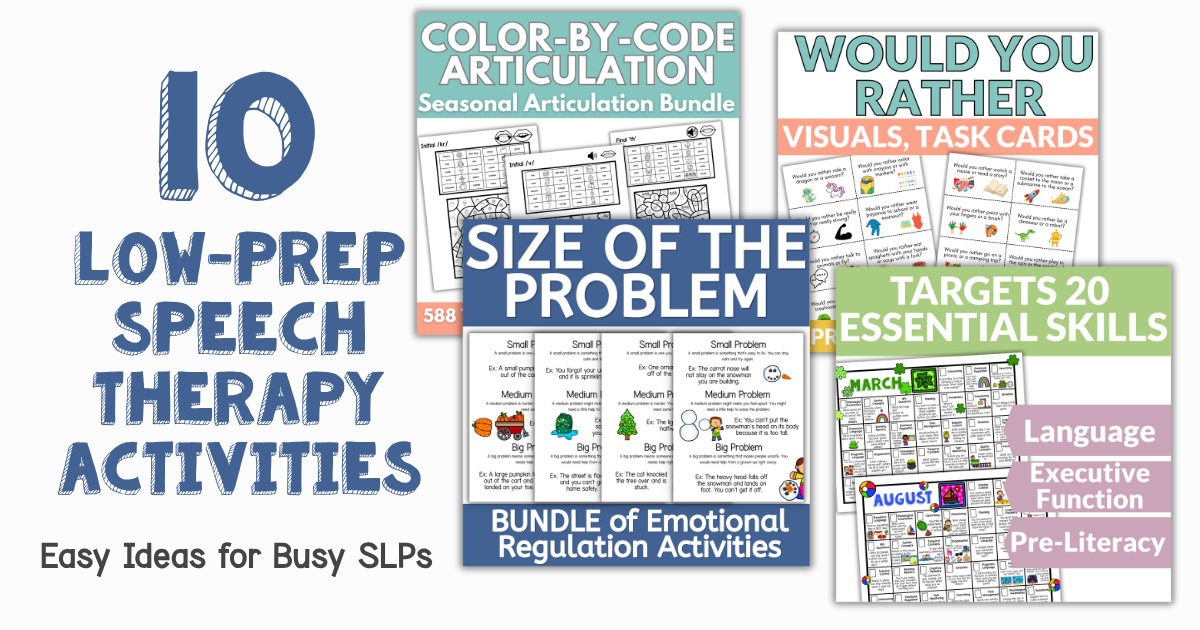
At Raising Warriors SLP, I create practical, engaging speech therapy resources designed to make planning easier for busy SLPs. From articulation activities and following directions picture scenes to executive functioning and problem-solving resources, my goal is to help you spend less time preparing and more time working with your students.
If you’re looking for printable activities to pair with your favorite games, I’d love for you to explore my Raising Warriors SLP TPT store.
And if you’re looking for even more ideas, check out my blog post, 10 Low-Prep Speech Therapy Activities for Busy School-Based SLPs, for additional ways to keep your sessions engaging without adding hours of preparation.
Because at the end of the day, it’s not about having the biggest collection of games or the fanciest therapy materials. It’s about finding meaningful ways to help students communicate, problem-solve, and grow—one turn at a time.