If you’re a school-based Speech-Language Pathologist, you know how quickly a busy therapy schedule can fill up. Between IEP meetings, progress monitoring, evaluations, and back-to-back speech sessions, finding time to plan engaging activities isn’t always easy.
After 20 years of working as an SLP, I’ve learned that effective speech therapy doesn’t have to involve hours of preparation. Some of my favorite activities are simple, flexible, and easy to adapt for students working on different goals.
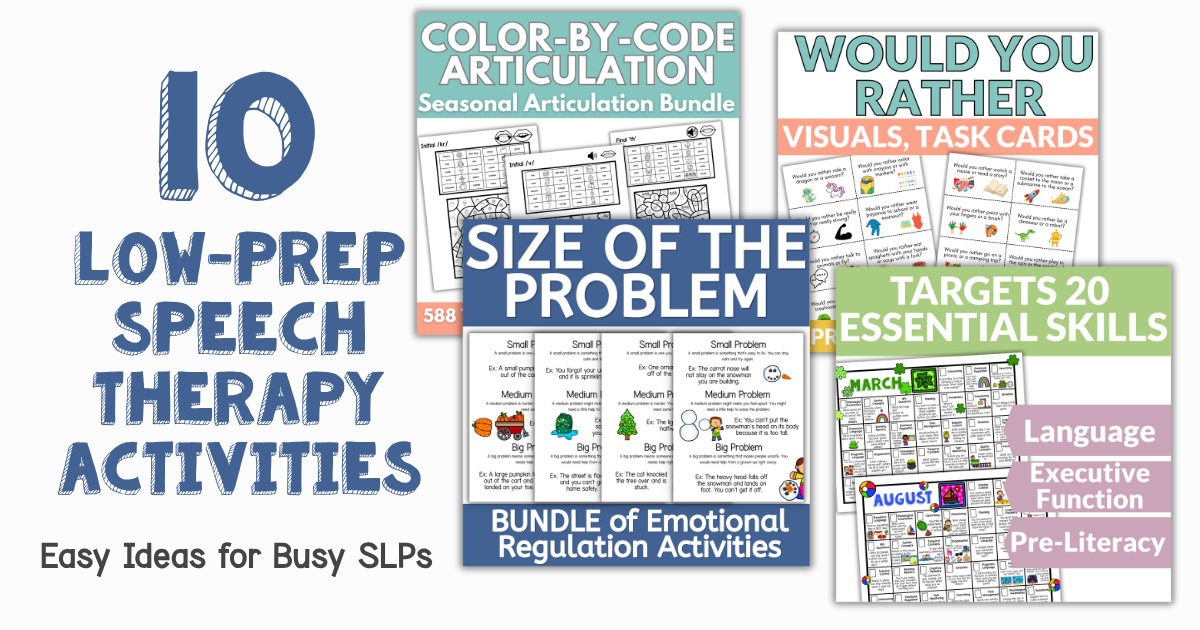
Whether you’re targeting articulation, expressive and receptive language, or executive functioning skills, these 10 low-prep speech therapy activities can help you make the most of your therapy time without adding more work to your already full plate.
10 Low-Prep Speech Therapy Activities to Try This Week
1. Use Picture Scenes to Target Multiple Speech and Language Goals
Picture scenes are one of my favorite tools for mixed speech therapy groups because students can work on completely different goals while using the same activity.
One student might practice articulation by naming objects in the picture, while another works on following one- or two-step directions. Other students can describe what they see, answer WH questions, make inferences, or expand simple sentences.
To make the activity even more interactive, have students draw or color objects as they follow directions. This adds a hands-on element without requiring a complicated setup.
Low-prep tip: Keep a few seasonal picture scenes ready to go. You can use the same scene across multiple sessions by changing the questions, directions, or language targets.
2. Build Language Skills with Would You Rather Questions
Would You Rather questions are an easy way to get students talking while targeting a variety of speech and language goals. They’re especially helpful when you have students working at different language levels in the same group.
Start with a simple question, such as, “Would you rather visit the beach or the mountains?” Then encourage students to explain their choices.
Younger students can practice answering questions, using complete sentences, and giving simple reasons. Older students can work on comparing and contrasting, making predictions, explaining their opinions, and considering different perspectives.
You can also incorporate articulation practice by having students use their target sounds when responding.
Low-prep tip: Keep a collection of seasonal Would You Rather questions handy. Use them as warm-ups, conversation starters, or quick activities when you have a few extra minutes at the end of a session.
3. Turn Articulation Practice into Simple, No-Prep Games
Articulation practice doesn’t have to mean drilling flashcards for an entire speech therapy session. With a few simple activities, you can keep students engaged while still getting plenty of opportunities to practice their target sounds.
One of my favorite strategies is to pair articulation practice with an easy game or printable activity. Students might color a section of a picture after practicing a set of words, move a game piece after producing their target sound, or complete part of a simple craft as they practice.
For students who need more repetitions, try a quick challenge: say five target words before taking a turn. You can easily adjust the number of repetitions based on each student’s needs.
Looking for more ways to keep students engaged without spending hours planning? Check out my 10 Favorite Speech Therapy Games That Target Multiple Goals for practical ideas to target articulation, language, and executive functioning in mixed groups.
Low-prep tip: Choose articulation activities that can be used with multiple sounds and at different levels, from single words to sentences. This makes it much easier to plan for mixed groups without preparing a separate activity for every student.
If your students enjoy hands-on articulation activities, my Never-Ending Articulation Books are another fun way to get repeated practice without relying on traditional flashcards. Students create an interactive folding book filled with target words they can practice during speech sessions and take home for additional practice.

4. Practice Executive Functioning with Everyday Problem-Solving Scenarios
Executive functioning skills are an important part of many speech therapy sessions, especially when working with students who struggle with planning, flexible thinking, emotional regulation, and problem-solving.
One of my favorite low-prep activities is presenting students with everyday situations and asking them to think through possible solutions.
For example, you might ask, “You forgot your homework at home. What could you do?” or “Your friend wants to play a different game than you. How could you handle that?”
Have students identify the problem, brainstorm two or three possible solutions, and discuss what might happen with each choice.
For younger students, picture cards and simple scenarios can make these abstract skills more concrete. Older students can work through more complex situations involving friendships, classroom expectations, and decision-making.
Low-prep tip: Use situations that are familiar to your students. Real-life scenarios make it easier to connect the skills practiced in speech therapy to situations students encounter throughout their school day.
Looking for a ready-to-use way to practice these skills? My Think-It-Through Problem-Solving Flipbooks help students explore everyday problems, consider possible choices, and think through the outcomes.

5. Build Vocabulary with Quick Category Challenges
Category activities are one of the easiest ways to target vocabulary, word relationships, and expressive language without spending time preparing materials.
Start by naming a category, such as animals, foods, school supplies, or things you find outside. Have students take turns naming items that belong in that category.
To increase the difficulty, ask students to explain why an item belongs, identify subcategories, or name something that doesn’t belong.
For older elementary students, you can also incorporate Tier 2 vocabulary by asking students to identify similarities, differences, and relationships between words.
One variation I enjoy is giving students a category and challenging them to name five items before time runs out. You can also reverse the activity by providing three related words and having students identify the category.
Low-prep tip: Keep a short list of categories on your desk or use categories connected to classroom themes. This makes it easy to adjust the activity for different ages and language abilities.
6. Use Sentence Expansion to Strengthen Expressive Language
Sentence expansion is a simple activity that can make a big difference for students working on expressive language skills.
Start with a basic sentence, such as “The dog runs.”
Then encourage students to add details by answering questions such as Who? What? Where? When? Why? and How?
For example:
- The dog runs.
- The brown dog runs.
- The brown dog runs through the park.
- The excited brown dog runs through the park to catch a ball.
Students can practice adding descriptive vocabulary, using more complex sentence structures, and organizing their ideas into complete sentences.
For younger students, pictures provide helpful visual support. Older students can work on combining sentences, adding conjunctions, and using more precise vocabulary.
Low-prep tip: Use pictures from books, classroom materials, or seasonal scenes you already have available. One picture can provide multiple opportunities for sentence expansion across different language levels.
7. Practice Following Directions with Draw-and-Color Activities
Following directions activities don’t have to involve complicated materials or elaborate setups. Sometimes all you need is a piece of paper and a few crayons.
Give students simple drawing or coloring directions, such as “Draw a circle at the top of your paper” or “Color the largest star blue.”
As students become more successful, increase the complexity by incorporating spatial concepts, temporal concepts, and multistep directions.
For example, “Before you color the flower, draw a butterfly next to it.”
You can also include directions containing words such as unless, except, either, neither, and after for students who are ready for more challenging language.
These activities provide opportunities to work on listening comprehension, working memory, attention, and understanding basic concepts.
Low-prep tip: Use one drawing scene for an entire mixed group. Simply adjust the complexity of the directions based on each student’s goals.
If you are looking for ready-to-use activities, my Following Directions Bundle includes engaging picture scenes that make it easy to target listening comprehension, basic concepts, and multistep directions. These activities are especially helpful for mixed speech therapy groups because you can adjust the directions to meet different students’ needs.

Looking for more ways to build receptive and expressive language skills? Check out my How To Teach Basic Concepts in Speech Therapy article for practical strategies, visual supports, and hands-on activities that work well in mixed-group sessions.
8. Strengthen Inferencing Skills with Mystery Clues
Inferencing can be challenging for students because it requires them to combine information they hear or see with what they already know.
A quick mystery clue activity is an engaging way to practice this skill without preparing an entire lesson.
Start by describing an object, place, or situation without naming it.
For example:
“I’m thinking of something that you wear when it rains. It helps keep your clothes dry, and it usually has a hood.”
Students use the clues to determine the answer and explain how they figured it out.
You can also make the activity more challenging by giving clues about emotions, social situations, or events.
For older students, ask them to identify which clues were most helpful and explain their reasoning.
Low-prep tip: Use familiar classroom objects, seasonal vocabulary, or everyday situations. Encourage students to create their own mystery clues for classmates to solve.
9. Use Simple Storytelling Activities to Build Narrative Language
Storytelling is a wonderful way to target sequencing, sentence formulation, vocabulary, and overall language organization.
One easy activity is to give students three words or pictures and challenge them to create a short story using all three.
For example, provide the words dog, backpack, and playground.
Students might create a story about a dog who finds a backpack at the playground.
Younger students can focus on telling what happened first, next, and last. Older students can add story elements such as characters, setting, problem, feelings, actions, and resolution.
You can also encourage students to retell their stories using transition words and complete sentences.
Low-prep tip: Keep a collection of picture cards or familiar vocabulary words available. Students can choose three at random to create a different story each session.
10. Build Flexible Thinking with Compare-and-Contrast Challenges
Compare-and-contrast activities are a simple way to build vocabulary, reasoning, and higher-level language skills.
Choose two familiar objects, activities, or situations and ask students to explain how they are alike and different.
For example, compare a bicycle and a scooter.
Students might identify that both have wheels and are used for transportation, but they differ in how they are ridden.
You can also compare less concrete ideas, such as two school activities, different ways to solve a problem, or characters from a story.
For students who need additional support, use pictures and sentence starters such as “Both ___ and ___” or “One difference is ___.”
Older students can practice explaining more complex relationships and supporting their responses with specific details.
Low-prep tip: Let students choose the two items to compare. Giving them some ownership often leads to more meaningful discussions and longer responses.
Making Low-Prep Speech Therapy Work for You
One thing I’ve learned throughout my years as an SLP is that successful therapy doesn’t require a different activity for every student or hours of preparation each week.
Some of the most effective activities are the ones that can be used again and again, with small adjustments to meet different students’ needs.
Whether you’re working on articulation, language, executive functioning, or social communication, having a collection of flexible activities can make your therapy sessions run more smoothly.
At Raising Warriors SLP, I create practical speech therapy resources with busy SLPs in mind. My goal is to help you spend less time preparing materials and more time working with your students.
If you’re looking for ready-to-use articulation, language, and executive functioning activities, I’d love for you to explore my resources!
Explore speech therapy activities at Raising Warriors SLP on Teachers Pay Teachers!
Leave a Reply