• 10 Speech Therapy Games That Target Multiple Goals

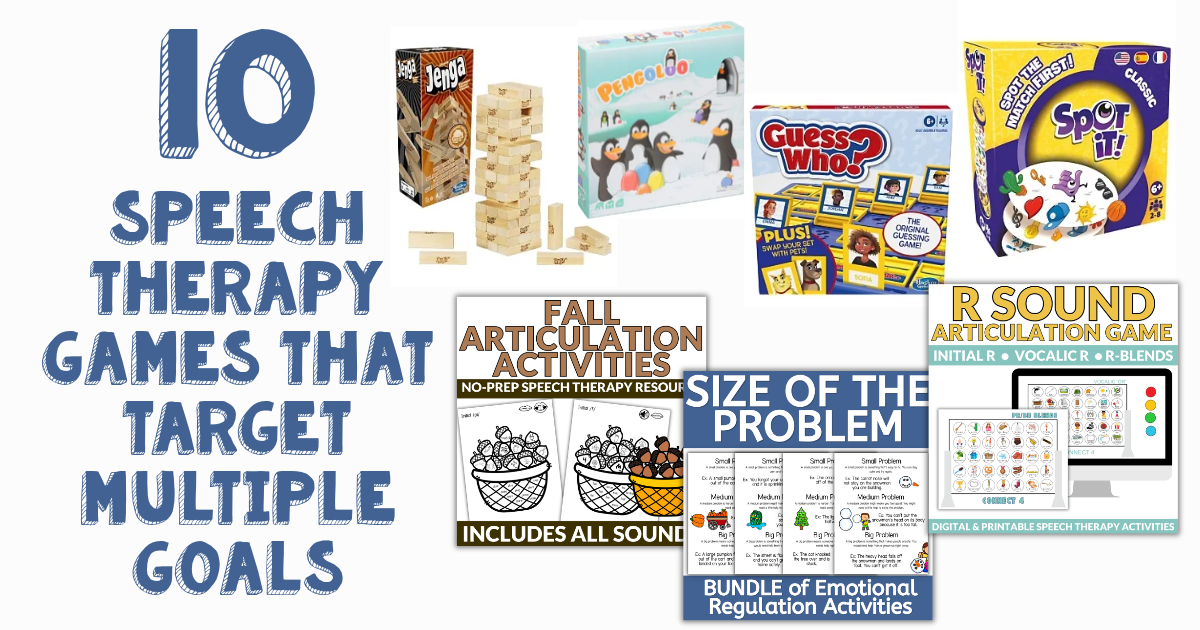
    10 Speech Therapy Games That Target Multiple Goals

    If you’re a school-based speech-language pathologist, you know that finding engaging speech therapy games for mixed groups can sometimes feel like a challenge. One student is working on articulation, another needs support with expressive language, and someone else is targeting executive functioning skills. How do you keep everyone engaged while making sure each student gets meaningful practice?

    After more than 20 years as a speech-language pathologist, I’ve learned that some of the best therapy activities aren’t necessarily designed for speech therapy at all. They’re everyday games that can be adapted to target multiple goals without requiring hours of preparation.

    In this post, I’m sharing 10 of my favorite speech therapy games that I actually use with students. From familiar favorites like Guess Who? and UNO to games like Pengoloo and Honeybee Tree, I’ll show you practical ways to target articulation, vocabulary, describing, following directions, problem-solving, and more.

    Whether you’re planning for a mixed group or simply looking for fresh ways to keep students motivated, these games can help you make the most of your therapy time.

    This post contains affiliate links. As an Amazon Associate I earn from qualifying purchases.

    1. Guess Who? – Describing, Asking Questions, and Inferencing

    Guess Who? is one of my favorite games for targeting multiple speech and language goals in a single session. While students are busy figuring out their opponent’s mystery character, they’re also practicing important communication skills.

    Speech Therapy Skills You Can Target:

    • Describing: Practice identifying and describing attributes such as hair color, clothing, facial features, and accessories.
    • Asking Questions: Help students formulate clear yes/no questions instead of simply guessing characters.
    • Categorization: Work on grouping characters by shared features and identifying similarities and differences.
    • Inferencing: Encourage students to use the information they’ve gathered to eliminate possibilities and make logical guesses.
    • Articulation: Have students practice target words or sentences before taking their turn.

    Mixed Group Therapy Tip: Give each student a different communication goal during the same game. One student might practice producing /r/ in questions, another might formulate complete sentences, and a third might work on asking relevant questions and using clues to narrow down the possibilities.

    Make It Easier: Provide sentence starters such as “Does your person have ___?” or “Is your person wearing ___?”

    Make It Harder: Challenge students to ask more strategic questions, explain why they eliminated certain characters, or describe their mystery person using multiple attributes.

    2. Sneaky Snacky Squirrel – Following Directions, Language, and Flexible Thinking

    The Sneaky, Snacky Squirrel Game is a favorite for practicing speech and language skills while keeping little hands busy! Students use squirrel-shaped tweezers to collect colorful acorns, making it a fun option for younger students who benefit from hands-on activities. I also love that it requires NO reading, making it a perfect game for our younger learners.

    What makes this game especially useful for speech therapy is how easily it can be adapted to target different goals without changing the basic gameplay.

    Speech Therapy Skills You Can Target:

    • Following Directions: Practice one-step and two-step directions using colors, actions, and sequencing. For example, “Pick up a red acorn, then put it in your log.”
    • Vocabulary and Basic Concepts: Target color words, counting, and concepts such as in, out, more, less, and empty.
    • Expressive Language: Encourage students to request colors, describe their acorns, and formulate complete sentences.
    • Articulation: Have students practice their target sounds or words before collecting an acorn.
    • Executive Functioning: Work on turn-taking, impulse control, flexible thinking, and managing disappointment when the spinner changes the game.

    Mixed Group Therapy Tip: Give each student a different task before their turn. One student might follow a two-step direction, another might produce five articulation targets, and a third might describe their acorn using a complete sentence. Everyone participates in the same game while working toward individual goals.

    Make It Easier: Use visual supports, model short phrases, or provide a choice of two colors. You can also simplify the spinner rules for students who need additional support.

    Make It Harder: Add multistep directions, require students to explain their choices, or introduce a problem-solving question when an unexpected spinner result occurs.

    One of my favorite things about using games like this in speech therapy is that students are practicing important communication and self-regulation skills while simply enjoying the game.

    I often will play this game alongside my Acorn Articulation activity. Instead of coloring each acorn, we often use the acorns from the Sneaky Snacky Squirrel Game to cover each picture!

    Fall acorn articulation speech therapy activity featuring 10 acorns with pictures students color while practicing their target speech sounds.

    3. Jenga – Articulation, Language, and Problem-Solving

    Jenga is one of those games I keep coming back to in speech therapy because it’s simple, engaging, and easy to adapt for almost any goal. Students take turns carefully removing wooden blocks from a tower and stacking them on top, all while trying to keep the tower from falling. The suspense alone is usually enough to keep everyone motivated!

    Speech Therapy Skills You Can Target:

    • Articulation: Have students practice a set number of target words, phrases, or sentences before removing a block. You can easily adjust the difficulty for each student.
    • Expressive Language: Ask students to describe their choices, formulate sentences, or answer questions before taking their turn.
    • Following Directions: Incorporate directions such as “Remove a block from the middle, then place it on top” or “Find a block below the top three rows.”
    • Problem-Solving: Encourage students to think about which blocks are safe to remove and predict what might happen if they choose a particular block.
    • Executive Functioning: Target planning, impulse control, flexible thinking, and emotional regulation as students carefully consider their moves and respond when the tower falls.

    Mixed Group Therapy Tip: Keep a small stack of articulation cards, language prompts, or executive functioning questions nearby. Each student completes a task related to their individual goal before taking a turn. This keeps everyone engaged in the same game without needing separate activities.

    Make It Easier: Build a shorter tower, offer choices between two blocks, or provide sentence starters and visual supports.

    Make It Harder: Have students explain their strategy before moving a block, predict the outcome of their choice, or complete a more challenging speech or language task before each turn.

    Bonus Tip: You don’t need to write on the blocks or attach anything to them! Keeping your Jenga set plain makes it easy to use with different students and therapy goals throughout the day.

    4. Spot It! – Vocabulary, Word Retrieval, and Attention

    Spot It! is a fast-paced matching game that works beautifully for speech therapy, especially when you only have a few minutes left in a session. Each pair of cards has one matching symbol, and students race to find and name it. The simple rules make it easy to introduce, while the variety of pictures provides plenty of opportunities to target different communication skills.

    One of the things I love about Spot It! is that you can slow the game down or change the rules depending on your students’ needs. It doesn’t always have to be a race!

    Speech Therapy Skills You Can Target:

    • Vocabulary: Have students name the matching pictures, describe their attributes, or identify the categories they belong to.
    • Word Retrieval: Encourage students to quickly name familiar objects. For students who need additional support, provide semantic or phonemic cues to help retrieve the word.
    • Articulation: Have students practice the matching word or use it in a sentence when it contains their target sound. You can also incorporate separate articulation cards between turns.
    • Expressive Language: Ask students to formulate sentences using the matching picture or explain how two pictured objects are alike or different.
    • Attention and Visual Scanning: Encourage students to carefully scan both cards, maintain attention, and identify the matching symbol.
    • Executive Functioning: Practice impulse control, flexible thinking, and emotional regulation, particularly when students need to wait, make a mistake, or lose a round.

    Mixed Group Therapy Tip: Instead of having everyone race to identify the matching symbol, take turns. One student might name and describe the picture, another might use it in a complete sentence, and a third might practice an articulation target before taking the next turn. This allows students with different goals to participate without the pressure of competing against one another.

    Make It Easier: Play cooperatively, remove the time pressure, and allow students extra time to scan the cards. Provide choices or verbal cues when needed.

    Make It Harder: Challenge students to name the matching symbol and then describe it using three attributes, formulate a complex sentence, or identify another word in the same category.

    Bonus Tip: For students working on self-regulation, try having everyone silently find the matching symbol before giving a signal to respond. It’s a simple way to practice waiting and impulse control while keeping the game engaging.

    One thing I really love about Spot It! is that there are so many different options! If you know my family, we OF COURSE have the Disney version. We also have the Junior version from when my kids were younger. For older boys students that may be a little harder to engage, the NFL version is a favorite!

    5. Connect 4 – Articulation, Planning, and Strategic Thinking

    Connect 4 is a classic game that works well for speech therapy because it’s quick to set up, easy to learn, and engaging for a wide range of ages. Students take turns dropping colored discs into a vertical grid, trying to connect four of their own pieces in a row. While the rules are simple, the game creates plenty of opportunities to practice communication and executive functioning skills.

    I especially like using Connect 4 with mixed groups because students can work on completely different goals without changing the game itself.

    Speech Therapy Skills You Can Target:

    • Articulation: Have students practice their target words, phrases, or sentences before dropping a disc into the grid. Adjust the number of repetitions or level of difficulty for each student.
    • Following Directions: Incorporate spatial concepts and multistep directions, such as “Put your red disc in the column next to the yellow disc” or “Find the column on the far right, then drop your piece.”
    • Expressive Language: Encourage students to explain their moves, describe the game board, or formulate complete sentences about their strategies.
    • Problem-Solving: Ask students to identify possible moves, predict what their opponent might do next, and explain how they could block an opponent from connecting four.
    • Planning and Organization: Encourage students to think ahead rather than choosing a column randomly.
    • Impulse Control and Flexible Thinking: Practice waiting for turns, considering choices before acting, and adjusting plans when an opponent makes an unexpected move.

    Mixed Group Therapy Tip: Use each turn as an opportunity to target an individual goal. One student might produce five articulation words, another might follow a spatial direction, and a third might explain their strategy using a complete sentence. Everyone stays involved in the same game while working on different skills.

    Make It Easier: Play cooperatively, model possible moves, or use a smaller portion of the board to simplify choices. For students working on articulation, begin with single-word practice before increasing complexity.

    Make It Harder: Challenge students to explain two possible moves and predict the outcome of each before choosing. You can also incorporate conditional directions, such as “If your opponent has three yellow discs in a row, find a way to block them before taking your turn.”

    Bonus Tip: Try a “Think Before You Drop” rule! Before placing a disc, students pause, look at the board, and explain their plan. This adds a simple executive functioning component without requiring any additional materials.

    I also created a Connect 4 Printable and Digital option specifically for singleton r, r-blends, and vocalic r! I wanted something that my students could use in therapy and then take home for additional practice.

    Printable Connect 4 speech therapy activity for practicing articulation, vocabulary, and language skills during engaging turn-taking games.

    6. Hedbanz – Describing, Categorization, and Asking Questions

    Hedbanz is a fun guessing game that gets students asking questions, thinking critically, and using descriptive language without even realizing how much they’re practicing! Each player wears a headband with a picture card they can’t see. By asking questions and listening to clues, students try to figure out what’s on their card.

    What makes Hedbanz especially useful for speech therapy is that students have to do more than simply name pictures. They need to think about categories, attributes, and the information they’ve already gathered to narrow down their guesses.

    Speech Therapy Skills You Can Target:

    • Asking Questions: Practice formulating relevant yes/no questions, such as “Am I an animal?” or “Can you find me in a kitchen?”
    • Describing: Have students describe objects using attributes such as category, function, appearance, location, and parts.
    • Categorization: Help students identify broad categories and narrow them down into more specific groups.
    • Inferencing: Encourage students to combine clues, eliminate possibilities, and make logical guesses.
    • Expressive Language: Practice complete sentences, sentence expansion, and explaining how clues support a guess.
    • Executive Functioning: Target working memory, planning, flexible thinking, and self-monitoring as students remember previous answers and adjust their questions.

    Mixed Group Therapy Tip: Assign different communication goals during the same round. One student might practice asking grammatically correct questions, another might provide clues using complete sentences, and a third might work on categorization or inferencing. Students working on articulation can practice their target sounds in questions or complete a separate set of target words before their turn.

    Make It Easier: Provide visual question starters, category choices, or a simple describing chart. You can also allow students to give additional clues rather than limiting responses to yes or no.

    Make It Harder: Challenge students to ask questions that eliminate multiple possibilities, remember previously answered questions, and explain why a particular guess makes sense.

    Bonus Tip: Try a “No Guessing Yet!” rule. Students must ask at least three meaningful questions before guessing their picture. This encourages them to gather information, think strategically, and avoid impulsive guesses.

    I recently made my own cards using free clipart and cardstock paper, and my 3rd and 4th graders loved it. The target words all contained vocalic r and they had SO many opportunities to practice their target sounds!

    7. UNO – Following Directions, Flexible Thinking, and Emotional Regulation

    UNO is a classic card game that can be used to target much more than matching colors and numbers! Between the Skip, Reverse, Draw Two, and Wild cards, students have plenty of opportunities to practice following directions, adapting to unexpected changes, and communicating with others.

    One reason UNO works so well in speech therapy is that the game naturally creates situations where students need to think before acting, remember rules, and manage their reactions when things don’t go as planned.

    Speech Therapy Skills You Can Target:

    • Following Directions: Practice understanding and following game rules, including directions involving colors, numbers, and actions. Add verbal directions such as “Before you play a red card, name two things that are red.”
    • Expressive Language: Encourage students to explain their choices, formulate complete sentences, and describe what’s happening during the game.
    • Articulation: Have students practice a set number of target words, phrases, or sentences before playing a card. Adjust the difficulty for each student.
    • Working Memory: Challenge students to remember whose turn comes next, track changes in direction, and recall the effects of special cards.
    • Flexible Thinking: Practice adapting when someone changes the color, reverses the direction of play, or skips a turn.
    • Emotional Regulation: Help students recognize feelings and practice appropriate responses when they have to draw additional cards, lose a turn, or don’t win.

    Mixed Group Therapy Tip: Keep articulation cards, language prompts, or problem-solving scenarios nearby. Before playing a card, each student completes a task related to their individual goal. For students targeting executive functioning, use naturally occurring moments during the game to discuss flexible thinking, impulse control, and managing disappointment.

    Make It Easier: Start with a smaller hand of cards, simplify the rules, or remove some of the action cards. Use visual reminders for students who need help remembering what each card means.

    Make It Harder: Ask students to explain how a special card changes the game, predict what might happen next, or practice conditional directions such as “If you have a blue card, play it. If you don’t, choose a card that matches the number.”

    Bonus Tip: Try a “Pause, Think, Play” strategy! Before each turn, have students stop, check the current color or number, and think about their options. This simple routine reinforces self-monitoring and impulse control without interrupting the fun.

    8. Pengoloo – Working Memory, Following Directions, and Language Skills

    Pengoloo is a fun memory game that gets students thinking, remembering, and communicating while they play! Colorful eggs are hidden beneath adorable penguins, and students roll dice to determine which colors they need to find. As they lift penguins and discover the hidden eggs, they have to remember where different colors are located.

    What makes Pengoloo particularly useful for speech therapy is that students can practice language skills while strengthening their ability to remember and use information during gameplay. I also love that this game requires no reading!

    Speech Therapy Skills You Can Target:

    • Working Memory: Encourage students to remember which colors are hidden beneath different penguins and use that information on future turns. Discuss strategies such as repeating information aloud or making mental associations.
    • Following Directions: Incorporate one-step and two-step directions, such as “Find a penguin with a yellow egg, then put it next to the blue penguin.”
    • Vocabulary and Basic Concepts: Practice color vocabulary, counting, and spatial concepts such as under, beside, between, next to, and behind.
    • Expressive Language: Have students describe their choices, formulate complete sentences, and explain where they think a particular egg is hidden.
    • Articulation: Students can practice target words or sentences before lifting a penguin or rolling the dice.
    • Executive Functioning: Target attention, planning, self-monitoring, and flexible thinking as students remember locations, make predictions, and adjust their choices.

    Mixed Group Therapy Tip: Give each student a different goal during the same game. One student might follow a two-step direction using spatial concepts, another might produce articulation targets, and a third might explain their reasoning or practice remembering the locations of previously revealed eggs.

    Make It Easier: Start with fewer penguins and egg colors. Allow students to name colors aloud, use visual supports, or play cooperatively to reduce the memory demands.

    Make It Harder: Challenge students to remember multiple egg locations, explain their strategies, or follow multistep directions involving colors and spatial concepts.

    Bonus Tip: After a student reveals an egg, ask everyone to describe its location using a complete sentence, such as “The green egg is under the penguin next to the red one.” This provides additional language practice while helping students rehearse information they may need on their next turn.

    9. Honeybee Tree – Impulse Control, Problem-Solving, and Emotional Regulation

    Honeybee Tree is a fun, suspenseful game that encourages students to slow down, think carefully, and manage their reactions! Players take turns removing leaves from a tree filled with bees, trying to avoid making the bees fall. As the game progresses, students have to consider their choices and respond when things don’t go exactly as planned.

    I love games like Honeybee Tree for speech therapy because they create natural opportunities to practice executive functioning and communication skills without requiring additional materials (Kerplunk is another favorite that is great for older kids and follows the same format!).

    Speech Therapy Skills You Can Target:

    • Impulse Control: Encourage students to pause and think before removing a leaf instead of immediately grabbing one.
    • Problem-Solving: Ask students to consider which leaf might be the safest to remove and explain their reasoning.
    • Predicting Outcomes: Have students predict what might happen if they remove a particular leaf and compare their prediction with the actual result.
    • Expressive Language: Practice complete sentences, describing actions, and explaining cause-and-effect relationships.
    • Articulation: Have students produce a set number of target words, phrases, or sentences before removing a leaf.
    • Emotional Regulation: Practice recognizing feelings and using coping strategies when bees fall unexpectedly or the game doesn’t go as planned.

    Mixed Group Therapy Tip: Each student can work on a different goal before removing a leaf. One student might practice articulation targets, another might predict what will happen using a complete sentence, and a third might practice a stop-and-think strategy before making a decision. Everyone participates in the same game while addressing individual communication goals.

    Make It Easier: Provide sentence starters such as “I think ___ will happen because ___.” Offer choices between two leaves, model appropriate reactions, or play cooperatively.

    Make It Harder: Ask students to compare two possible moves, explain which they think is safer, and justify their predictions. You can also challenge students to identify how they might respond if an unexpected outcome occurs.

    Bonus Tip: Before each turn, ask students to finish the sentence, “If I pull this leaf, then ___.” This is a simple way to incorporate conditional language, predicting, and cause-and-effect reasoning into gameplay.

    10. Tapple – Vocabulary, Word Retrieval, and Categorization

    Tapple is a fast-paced word game that challenges students to think of words within a specific category before the timer runs out. Players take turns naming an item that fits the category and pressing the corresponding beginning-letter button. Once a letter has been used, it can’t be used again during that round!

    I love how easily Tapple can be adapted for speech therapy. While the timer adds excitement, it can also be removed or modified to give students more time to think, retrieve vocabulary, and formulate responses.

    Speech Therapy Skills You Can Target:

    • Categorization: Practice generating words within categories such as animals, foods, transportation, school supplies, and clothing.
    • Word Retrieval: Encourage students to retrieve vocabulary based on semantic categories. Provide semantic or phonemic cues when needed.
    • Phonological Awareness: Have students identify the beginning sound of their chosen word and connect it to the corresponding letter. Remember that some letters represent multiple sounds, so the sound and spelling won’t always match!
    • Expressive Language: Challenge students to use their chosen word in a complete sentence, describe its attributes, or explain how it fits the category.
    • Articulation: Choose categories that encourage students to generate words containing their target sounds, or incorporate separate articulation practice before each turn.
    • Executive Functioning: Target cognitive flexibility, working memory, attention, and impulse control as students generate new responses, remember previously used words, and adjust their thinking.

    Mixed Group Therapy Tip: Use the same category but assign different goals to each student. One student might generate a word containing their articulation target, another might use their word in a complete sentence, and a third might explain why their word belongs in the category. This allows everyone to participate in the same game while practicing individual communication goals.

    Make It Easier: Turn off the timer or extend the response time. Use familiar categories, provide visual supports, or allow students to brainstorm possible answers before beginning.

    Make It Harder: Choose more abstract categories, require students to explain their answers, or challenge them to generate multiple words with different beginning sounds. For older students, try Tier 2 vocabulary categories or categories involving multiple-meaning words.

    Bonus Tip: Try a “Describe It Before You Tap It” variation! Students must name an item and provide one additional detail about it before pressing the letter. This encourages more meaningful language practice instead of simply generating words as quickly as possible.

    Teaching Emotional Regulation Through Speech Therapy Games

    One of the biggest benefits of using games in speech therapy has nothing to do with winning! Games provide natural opportunities to practice flexible thinking, problem-solving, and emotional regulation.

    Lately, I’ve been working with quite a few students who benefit from direct instruction in understanding the size of a problem and matching the size of their reaction. Losing a game, missing a turn, drawing an unwanted card, or watching the Jenga tower fall can feel like a very big deal to some students.

    And while it’s easy to remind a student to “be a good sport,” that doesn’t necessarily teach them what to do when they’re frustrated.

    Teach the Skill Before the Game

    I like to introduce the concept of problem size and reaction size outside of a frustrating situation. Students practice identifying problems, discussing how big those problems are, and exploring different ways to respond.

    For example:

    • Situation: You lose a game of UNO.
    • How might you feel? Disappointed, frustrated, or upset.
    • What can you do? Take a breath, ask for a short break, use positive self-talk, or congratulate the winner when you’re ready.
    • What could you say? “I’m disappointed that I lost, but I can try again.”

    It’s important to help students understand that all feelings are okay, even when those feelings are big. The goal isn’t to tell students they shouldn’t be upset about losing. Instead, we’re helping them recognize their emotions and choose safe, respectful ways to respond.

    Practice During Real Games

    Once students understand the concepts, games like UNO, Jenga, Honeybee Tree, and Connect 4 provide opportunities to practice using those strategies.

    Before beginning, we might talk about what could happen during the game and choose a strategy to try if something doesn’t go as planned.

    Afterward, students can reflect on what they felt, which strategy they used, and what they might try next time.

    How to Use These Games in Mixed Speech Therapy Groups

    One of the biggest challenges of school-based speech therapy is planning activities for students with different communication goals. You might have one student working on articulation, another targeting vocabulary, and a third practicing following directions or problem-solving.

    The good news? You don’t need three separate activities to address three different goals!

    Here are a few strategies I use to make games work for mixed groups:

    • Keep the game the same, but change the expectations. One student might practice five articulation words before taking a turn, while another answers a language question or explains a strategy.
    • Have materials ready before starting. Keep articulation cards, vocabulary prompts, or language activities nearby so you can quickly individualize each student’s practice.
    • Adjust the level of support. Some students benefit from picture choices or sentence starters, while others are ready for open-ended questions and more complex language.
    • Build in opportunities for repetition. Games are motivating, but meaningful therapy also requires enough opportunities to practice target skills. Keep turns moving so students spend more time practicing than waiting.
    • Know when to simplify the rules. You don’t always need to play a game exactly as written. Shorter rounds, cooperative play, and modified rules can make games more accessible for students with different needs.

    The goal isn’t simply to keep everyone entertained. It’s to create opportunities for meaningful communication practice while helping students stay engaged and participate successfully.

    Teaching Emotional Regulation Through Speech Therapy Games

    One of the most valuable things about using games in speech therapy is that they create natural opportunities to practice skills beyond articulation and language. Games can also help students work on flexible thinking, problem-solving, and emotional regulation.

    Lately, I’ve been working with quite a few students who benefit from direct instruction in understanding the size of a problem and matching the size of their reaction. Losing a game, missing a turn, drawing an unwanted card, or watching the Jenga tower fall can feel like a really big deal!

    And while it’s easy to remind students to “be good sports,” that doesn’t necessarily teach them what to do when they’re frustrated.

    Teach Emotional Regulation Before Playing

    I find it helpful to introduce these concepts before students encounter a frustrating situation. We practice identifying the size of a problem, recognizing how different situations might make us feel, and discussing safe, respectful ways to respond.

    For example, consider a student who loses a game of UNO.

    • What happened? I lost the game.
    • How might I feel? Disappointed, frustrated, or upset.
    • What could I do? Take a breath, ask for a break, use positive self-talk, or try again another time.
    • What could I say? “I’m disappointed that I lost, but I can handle it.”

    It’s important to remind students that all feelings are okay, even big feelings. The goal isn’t to eliminate frustration or disappointment. Instead, we’re helping students learn how to recognize their emotions and choose appropriate ways to respond.

    Practice the Skills During Games

    Once students have practiced these concepts through direct instruction, games provide opportunities to apply them.

    Before playing, I might ask students what could happen during the game that could be frustrating. We talk through possible reactions and choose a strategy to try if things don’t go as planned.

    After the game, we can reflect on what happened, how students felt, and whether they were able to use a strategy.

    And sometimes, the biggest success isn’t winning or losing gracefully. It’s a student recognizing that they’re frustrated and independently asking for a break.

    Looking for Structured Emotional Regulation Activities?

    For students who benefit from additional practice, I’ve created Size of the Problem and Reaction Size speech therapy resources that provide visual supports, problem-sorting activities, and opportunities to discuss different reactions.

    These resources help students identify problems, recognize emotions, think through possible responses, and practice matching their reactions to different situations.

    I especially like combining structured instruction with real gameplay. Students can first work through hypothetical situations using visual supports and then practice applying those skills during games like UNO, Jenga, Connect 4, and Honeybee Tree.

    When students receive explicit instruction, repeated practice, and appropriate support, they have more opportunities to develop strategies they can use beyond the speech therapy room.

    Speech therapy visual for teaching size of the problem and reaction size, helping elementary students identify emotions and practice appropriate responses.

    Making the Most of Speech Therapy Games

    The best speech therapy games aren’t necessarily the ones designed specifically for speech therapy. Sometimes, the games already sitting on your shelf provide the most opportunities for meaningful communication practice!

    Whether you’re using Guess Who? to practice describing, Tapple to strengthen word retrieval, or UNO to work on flexible thinking, a little creativity can turn familiar games into valuable therapy tools.

    And when you’re working with mixed groups, having activities that can address multiple goals makes planning so much easier.

    Looking for More Low-Prep Speech Therapy Activities?

    At Raising Warriors SLP, I create practical, engaging speech therapy resources designed to make planning easier for busy SLPs. From articulation activities and following directions picture scenes to executive functioning and problem-solving resources, my goal is to help you spend less time preparing and more time working with your students.

    If you’re looking for printable activities to pair with your favorite games, I’d love for you to explore my Raising Warriors SLP TPT store.

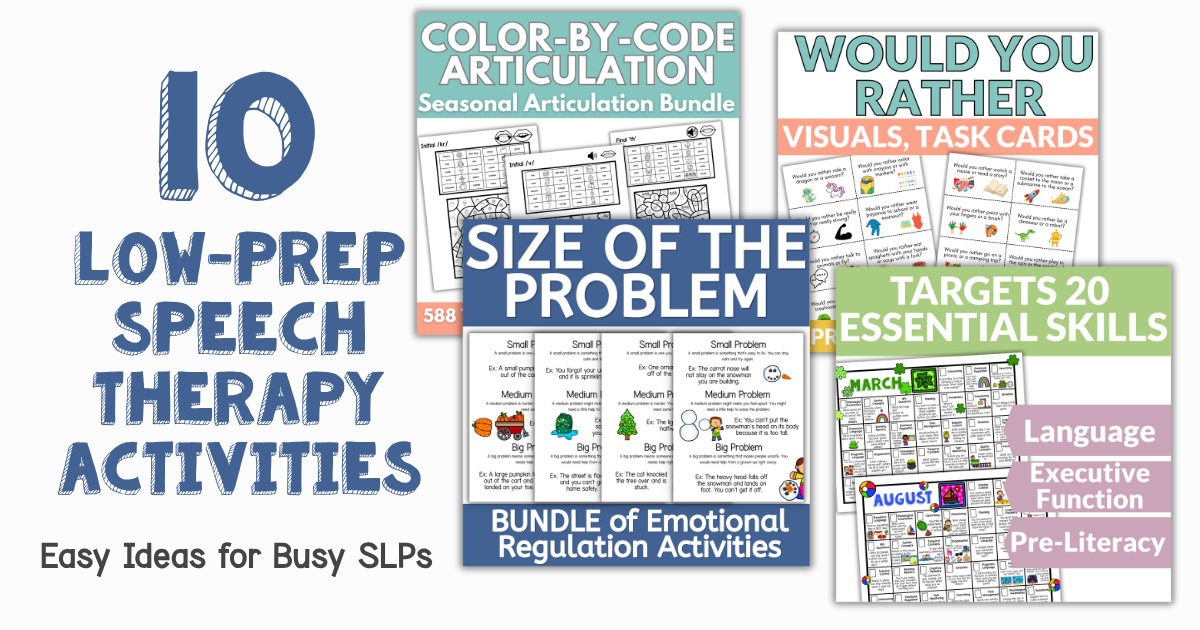
    And if you’re looking for even more ideas, check out my blog post, 10 Low-Prep Speech Therapy Activities for Busy School-Based SLPs, for additional ways to keep your sessions engaging without adding hours of preparation.

    Because at the end of the day, it’s not about having the biggest collection of games or the fanciest therapy materials. It’s about finding meaningful ways to help students communicate, problem-solve, and grow—one turn at a time.
  • 10 Executive Functioning Activities for Elementary Speech Therapy

    10 Executive Functioning Activities for Elementary Speech Therapy

    If you’ve ever worked with a student who struggles to follow multistep directions, gets frustrated when plans change, or has difficulty organizing their thoughts, you’ve probably seen executive functioning challenges in action.

    Executive functioning skills play an important role in how students learn, communicate, solve problems, and navigate everyday situations. And while these skills are often associated with classroom learning, they also overlap with many of the language and social communication goals we address in speech therapy.

    The good news? You don’t need elaborate materials or an entirely separate lesson to incorporate executive functioning into your sessions!

    In this post, I’m sharing 10 executive functioning activities for elementary speech therapy. These 10 executive functioning activities for speech therapy help elementary students strengthen planning, working memory, flexible thinking, and problem-solving skills without adding hours to your prep time.

    Whether you have five minutes left in a session or want to build an entire lesson around executive functioning, you’ll find ideas you can put to use right away.

    Why Use Executive Functioning Activities for Speech Therapy?

    Executive functioning skills are the mental processes that help us manage our thoughts, actions, and emotions to accomplish goals. Think of them as the brain’s management system. These skills help students remember instructions, stay focused, adjust when something unexpected happens, and think through their choices before acting.

    For elementary students, executive functioning skills are developing throughout the school years. Some students need additional support learning how to use these skills successfully in the classroom, during conversations, and in everyday routines.

    Here are several executive functioning skills that frequently overlap with speech therapy goals:

    • Working Memory: Holding information in mind long enough to use it, such as remembering the steps in a direction.
    • Planning and Organization: Thinking ahead, identifying necessary steps, and putting ideas or actions in a logical order.
    • Cognitive Flexibility: Adjusting to changes, considering different perspectives, and trying another strategy when something doesn’t work.
    • Inhibitory Control: Pausing before responding, resisting distractions, and thinking before acting.
    • Emotional Regulation: Recognizing emotions and using strategies to respond appropriately to challenging situations.
    • Self-Monitoring: Recognizing when something isn’t working, checking your work, and making adjustments.

    These skills don’t develop overnight, and students may demonstrate strengths in one area while needing support in another.

    As speech-language pathologists, we can help students practice the language and communication skills that support executive functioning, particularly when difficulties affect following directions, organizing spoken language, problem-solving, and social interactions.

    10 Executive Functioning Activities for Elementary Speech Therapy

    1. Use Problem-Solving Flipbooks to Practice Thinking Ahead

    One of my favorite ways to target executive functioning during speech therapy is through everyday problem-solving scenarios. Students often know what they should do when a problem occurs, but actually thinking through their choices in the moment can be challenging.

    Problem-solving flipbooks provide a visual, structured way to practice this important skill.

    I like using a simple four-step approach:

    1. What happened? Identify the problem and explain the situation.
    2. What could you do? Brainstorm possible choices.
    3. What might happen next? Predict the outcome of each choice.
    4. What’s the best choice? Select a reasonable solution and explain why.

    For younger students in kindergarten through second grade, start with familiar situations, such as someone taking a toy, forgetting a school supply, or not getting a turn during a game. Picture supports and simple choices can make the process more manageable.

    For students in grades 3–5, introduce situations with multiple possible solutions. Encourage students to compare outcomes, consider another person’s perspective, and explain how they would adjust their plan if their first solution didn’t work.

    Executive functioning skills targeted: Planning, cognitive flexibility, inhibitory control, and self-monitoring.

    Speech therapy connections: Inferencing, predicting, sequencing, expressive language, and social communication.

    Low-prep tip: Keep a few problem-solving scenarios ready for the last five minutes of a session. Students can talk through the steps without needing to complete an entire worksheet.

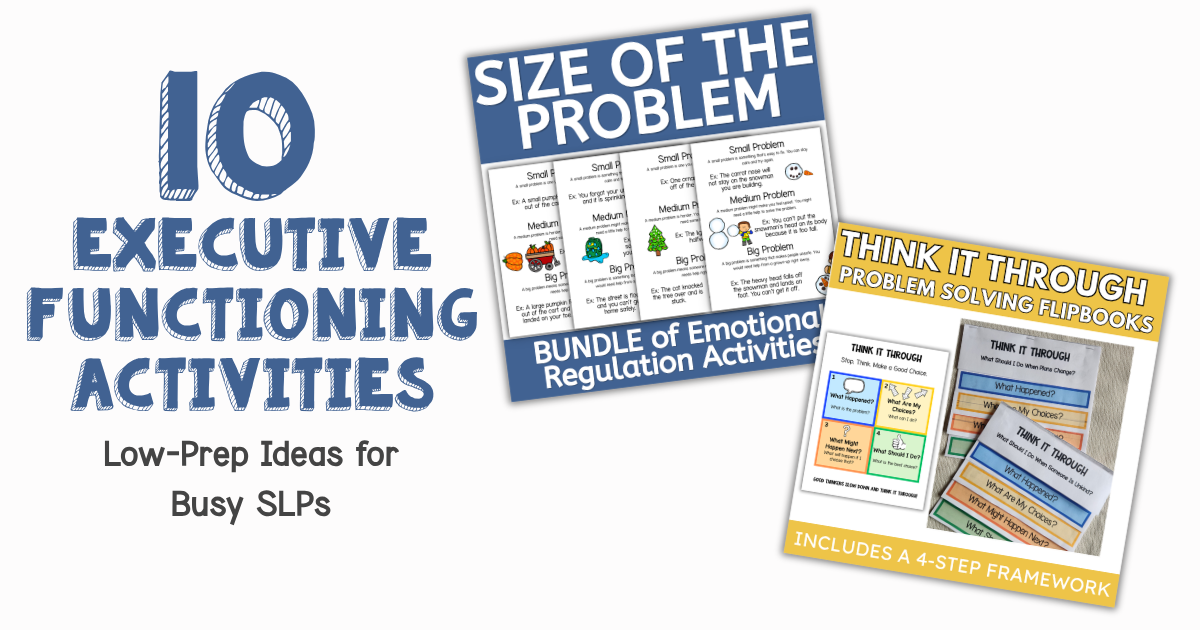
    I created my Think It Through Problem-Solving Flipbooks to give students a consistent visual routine for working through everyday challenges. The same four questions can also be practiced during classroom situations, read-alouds, or conversations about real-life problems.

    Interactive problem-solving flipbooks for elementary speech therapy showing four steps for making choices, predicting outcomes, and solving everyday problems.

    2. Practice Planning and Sequencing with Everyday Missions

    Planning and organization can be challenging for elementary students, especially when a task involves several steps. Some students know what they want to accomplish but have difficulty figuring out where to begin, what materials they’ll need, or what order makes the most sense.

    One simple way to practice these skills in speech therapy is by giving students an everyday mission to complete.

    Try scenarios such as:

    • You’re having a birthday party. What do you need to do to get ready?
    • Your class is going on a field trip. What should you pack?
    • You want to make a sandwich. What materials and steps do you need?
    • You’re planning a lemonade stand. What needs to happen before you can open?
    • Your family is going on a picnic. How will you get everything ready?

    Ask students to identify their goal, gather the necessary materials, and organize the steps in a logical order.

    Then add a challenge! What if it starts raining during the picnic? What if you forget something important? What if you don’t have enough time to finish everything?

    These unexpected changes encourage students to evaluate their original plan and think about possible adjustments.

    For K–2 students: Use picture cards or drawings to represent three or four steps. Have students arrange the pictures in order and explain what happens first, next, and last.

    For grades 3–5: Encourage students to create their own plans, estimate how much time each step might take, prioritize important tasks, and identify possible obstacles.

    Executive functioning skills targeted: Planning, organization, cognitive flexibility, time management, and self-monitoring.

    Speech therapy connections: Sequencing, narrative organization, temporal concepts, expressive language, and problem-solving.

    Low-prep tip: You don’t need special materials! Write an everyday mission on a sticky note or whiteboard and have students talk through their plan. For mixed groups, one student can sequence the steps while another explains the reasoning behind the plan.

    To make the activity more challenging, ask students to explain why they chose a particular order or what they would do differently next time. This encourages students to reflect on their thinking rather than simply completing the task.

    3. Strengthen Flexible Thinking with “What If?” Scenarios

    Flexible thinking is an important executive functioning skill that helps students adjust when something doesn’t go as expected. Whether a game changes, a preferred activity is unavailable, or a classmate has a different idea, students benefit from practicing how to consider alternatives.

    One easy way to build cognitive flexibility during speech therapy is through “What If?” scenarios.

    Present a familiar situation, then introduce an unexpected change.

    Try these examples:

    • You planned to play outside, but it starts raining. What could you do instead?
    • Your favorite game is missing a piece. How could you still play?
    • Your group wants to play a different game than you do. What are some options?
    • You forgot the supplies you need for a project. What’s another way to complete it?
    • You practiced a presentation, but now you have to present first. How could you adjust?

    Challenge students to come up with at least two possible solutions. Then discuss which choices might work best and why.

    For K–2 students: Start with two visual choices and model flexible-thinking language such as “I could try…” or “Another idea is…”

    For grades 3–5: Ask students to generate multiple solutions independently, compare possible outcomes, and explain how different people might respond to the same situation.

    Executive functioning skills targeted: Cognitive flexibility, planning, emotional regulation, and self-monitoring.

    Speech therapy connections: Problem-solving, perspective-taking, predicting, expressive language, and social communication.

    Low-prep tip: Turn this into a quick group challenge! Give students 30 seconds to brainstorm as many reasonable solutions as they can. Then discuss how different ideas might work in different situations.

    I also like to remind students that flexible thinking doesn’t mean they always have to agree with others or give up their preferences. It’s about recognizing that there may be more than one way to approach a situation and learning how to communicate and adapt when needed.

    4. Match the Size of the Problem to the Size of the Reaction

    Helping students recognize the difference between a small problem and a big problem is a practical way to incorporate emotional regulation, flexible thinking, and problem-solving into speech therapy.

    Start by presenting familiar situations and asking students to consider how serious each problem is. For example:

    • Your pencil breaks during class.
    • Someone gets to be first in line instead of you.
    • You forget your homework at home.
    • A classmate accidentally bumps into you.
    • Someone gets hurt on the playground.

    Have students sort the situations into small, medium, and big problems. Then discuss what an appropriate response might look and sound like.

    The important part isn’t just sorting the problems correctly. It’s helping students understand that different situations may require different responses, and that two people might experience the same situation differently.

    For students in K–2, use picture cards, emotion visuals, and simple questions such as, “What could you do?” or “Who could help?”

    For students in grades 3–5, introduce more complicated scenarios. Ask students to consider how their initial reaction might affect the situation, identify coping strategies, and discuss what they could do if their first strategy doesn’t help.

    Executive functioning skills targeted: Emotional regulation, inhibitory control, cognitive flexibility, and self-monitoring.

    Speech therapy connections: Emotion vocabulary, perspective-taking, inferencing, explaining choices, and social communication.

    Low-prep tip: Use situations that naturally come up during games or group activities. If a student doesn’t get the turn they wanted or a game doesn’t go as planned, you have an opportunity to model flexible thinking and appropriate responses.

    I use this approach in my Size of the Problem and Reaction Size activities, which include sorting mats, problem scenarios, and visual supports to help students talk through their reactions.

    One important reminder: The goal isn’t to tell students that their feelings are too big or wrong. Instead, we’re helping them recognize their emotions, consider the situation, and choose responses that are safe, respectful, and helpful.

    Spring and summer speech therapy activities for identifying problem sizes, matching reaction sizes, and practicing emotional regulation with visual posters and sorting activities.

    5. Strengthen Working Memory with Quick, No-Prep Games

    Working memory helps students hold information in mind while using or manipulating it. It’s an important skill for following directions, participating in conversations, organizing sentences, and completing classroom tasks.

    The great thing about working memory activities is that you don’t need elaborate materials. Some of my favorite activities can be completed with nothing more than a few words, pictures, or objects already in your speech room.

    Try these three quick working memory games:

    1. Remember and Repeat

    Say three related words, such as “apple, banana, orange.” Ask students to repeat them in the same order. Gradually increase the number of words or add a short delay before they respond.

    For an added language challenge, have students identify the category or use the words in a sentence after recalling them.

    2. What’s Missing?

    Place four or five familiar objects on the table. Give students time to look at them, then have them close their eyes while you remove one object.

    Ask, “What’s missing?”

    To increase the challenge, remove two objects or ask students to describe where the missing objects were located.

    3. Listen, Remember, and Organize

    Read a short list of words, such as “dog, apple, cat, banana.” Ask students to remember the words and then organize them into categories.

    This activity challenges students to hold information in mind while also thinking about how the words are related.

    For K–2 students: Start with two or three familiar items and provide visual supports when needed. Teach strategies such as repeating information aloud, grouping related items, or creating a mental picture.

    For grades 3–5: Increase the amount of information, introduce short delays, or ask students to reorganize information according to specific rules.

    Looking for more ways to practice executive functioning skills through play? Explore my 10 Speech Therapy Games That Target Multiple Goals for ideas that incorporate planning, flexible thinking, problem-solving, and emotional regulation.

    Executive functioning skills targeted: Working memory, attention, and self-monitoring.

    Speech therapy connections: Vocabulary, categorization, auditory comprehension, word retrieval, and expressive language.

    Low-prep tip: Use vocabulary words or articulation targets students are already practicing. This allows you to incorporate a working memory challenge without abandoning their primary speech or language goals.

    Remember that the goal isn’t simply to make the task harder. Pay attention to which strategies help students succeed, and encourage them to recognize when they need to repeat, organize, or write down information. These strategies can be especially valuable when applied to classroom tasks.

    6. Practice Impulse Control with Stop-and-Think Games

    Games are a natural way to practice inhibitory control, an executive functioning skill that helps students pause before acting, resist distractions, and think about their responses.

    One of my favorite ways to target this skill is by adding a simple “stop and think” challenge to familiar speech therapy activities.

    Try these three easy games:

    1. Do the Opposite

    Give students a simple direction, but ask them to do the opposite action. For example, when you say “stand,” they sit. When you say “hands up,” they put their hands down.

    Start with two familiar actions before introducing additional rules.

    2. Wait for the Magic Word

    Give students directions, but explain that they should only respond when the direction begins with a specific word, such as “Ready.”

    For example, “Ready, touch your nose” means students should respond, while “Touch your ears” means they should wait.

    3. Think Before You Answer

    Ask students familiar questions, but introduce a short waiting period before they respond. Students can silently think of their answers, then respond when given a signal.

    For an additional language challenge, ask students to explain their answers using complete sentences.

    For K–2 students: Use simple directions, visual reminders, and predictable rules. Model what it looks like to pause and listen before responding.

    For grades 3–5: Introduce changing rules, more complex directions, or situations that require students to explain why they chose a particular response.

    Executive functioning skills targeted: Inhibitory control, attention, working memory, and cognitive flexibility.

    Speech therapy connections: Following directions, auditory comprehension, expressive language, and conversational turn-taking.

    Low-prep tip: Add a stop-and-think rule to a game you’re already using. Students can practice waiting, listening, and checking the directions while continuing to work on their individual speech or language goals.

    Remember that students may respond impulsively for different reasons, including difficulty understanding the directions. Keep the language manageable so you’re practicing the intended skill rather than making the activity unnecessarily confusing.

    The goal isn’t to make students respond more slowly all the time. It’s to help them recognize situations when pausing, listening, and thinking before acting can be useful.

    7. Build Working Memory with Following Directions Challenges

    Following directions is a natural way to incorporate working memory into speech therapy. Students need to listen, understand the language, hold information in mind, and remember what to do next.

    One of my favorite ways to practice these skills is with picture scenes. Students can follow directions by drawing, coloring, or adding objects to a scene, making the activity interactive without requiring a lot of preparation.

    Start with simple directions such as:

    • “Color the dog brown.”
    • “Draw a ball next to the tree.”
    • “Circle the bird, then color the flower yellow.”

    Once students are successful, increase the working memory demands by adding more steps or requiring students to wait briefly before responding.

    For example, show students a picture scene and say, “Draw a sun above the house, put three flowers beside the fence, and color the door blue.”

    Before they begin, ask students to repeat the directions or explain their plan. Then have them complete the task and check their work.

    For K–2 students: Begin with one- and two-step directions using familiar vocabulary. Provide visual supports, repeat directions when appropriate, and explicitly teach strategies such as repeating information aloud or using fingers to remember steps.

    For grades 3–5: Incorporate temporal concepts, conditional directions, and multiple details. Encourage students to identify the most important information, mentally rehearse the steps, and independently check their completed work.

    Executive functioning skills targeted: Working memory, sustained attention, planning, and self-monitoring.

    Speech therapy connections: Receptive language, basic concepts, auditory comprehension, sequencing, and following directions.

    Low-prep tip: Use the same picture scene with your entire group! One student might follow two-step directions while another works on conditional directions or explaining the sequence of actions.

    I love using following directions picture scenes because they allow students to practice language and executive functioning skills together. My Following Directions Picture Scenes Growing Bundle includes themed scenes that can be adapted for different students and therapy goals.

    Remember that difficulty following directions doesn’t always indicate a working memory weakness. Vocabulary knowledge, language comprehension, attention, and task familiarity can also affect performance. Adjust the language demands and memory demands separately when possible.

    Winter following directions speech therapy worksheet featuring a skiing and snowboarding picture scene with one-step and two-step drawing and coloring directions.

    8. Build Self-Monitoring Skills with Check-and-Fix Challenges

    Self-monitoring is an important executive functioning skill that helps students recognize when something isn’t working, evaluate their performance, and make adjustments.

    In speech therapy, we use self-monitoring all the time! Students might listen for their target speech sound, check whether they included important details in a sentence, or notice when a listener doesn’t understand their message.

    One simple way to practice this skill is through a “Check and Fix” challenge.

    Give students a short task with an intentional mistake and ask them to identify what needs to be corrected.

    Try these three activities:

    1. Silly Sentence Detective

    Say or write a sentence with an error, such as “Yesterday, the boy goed to the park.”

    Ask students to identify the mistake, correct it, and explain how they knew something wasn’t right.

    2. Direction Detective

    Show students a completed picture scene that doesn’t match the directions.

    For example, say, “The directions were to draw three stars above the house and color the door red.”

    If the picture has two stars and a blue door, students must identify what needs to be fixed.

    3. My Own Work Check

    After completing a speech or language activity, have students pause and review their work using three questions:

    • Did I follow the directions?
    • Did I include everything I needed?
    • Is there anything I want to change or improve?

    For K–2 students: Use simple pictures, short sentences, and visual checklists. Model how to identify one mistake and make a correction.

    For grades 3–5: Introduce tasks with multiple errors or ask students to independently develop a checklist before beginning an activity.

    Executive functioning skills targeted: Self-monitoring, attention, planning, and cognitive flexibility.

    Speech therapy connections: Speech sound self-monitoring, grammar, sentence formulation, following directions, and narrative organization.

    Low-prep tip: Build a quick self-check into activities you’re already doing. Before students finish, ask, “How do you know you completed the task correctly?” or “What could you improve?”

    One important distinction: Finding mistakes in someone else’s work is often easier than recognizing errors in your own. Gradually move from identifying obvious mistakes in prepared examples to checking real work and communication attempts.

    The goal is to help students become more independent in recognizing when they need to pause, check their work, and make adjustments—not to expect perfection on every attempt.

    9. Practice Organization and Prioritizing with ‘What Comes First?’ Challenges

    Organization and prioritizing help students determine what needs to be done, decide which tasks are most important, and manage their responsibilities.

    For elementary students, these skills come into play throughout the school day. From getting ready for class to completing assignments and managing materials, students are constantly making decisions about what to do first.

    One easy way to practice these skills in speech therapy is with a “What Comes First?” challenge.

    Present students with a situation and several tasks that need to be completed. Ask them to decide which tasks should happen first, which can wait, and why.

    Try these everyday scenarios:

    1. Getting Ready for School

    You need to eat breakfast, pack your backpack, brush your teeth, and put on your shoes. What should you do first? Does everything need to happen in a specific order?

    2. The Classroom Cleanup Challenge

    There are books on the floor, markers without caps, papers scattered across a table, and chairs that need to be pushed in. You only have two minutes before leaving. What should you take care of first?

    3. The Homework Challenge

    You have a spelling assignment due tomorrow, a book report due next week, and a permission slip that needs to be signed tonight. How would you decide what to work on first?

    For K–2 students: Present three or four tasks using pictures or simple verbal descriptions. Have students sort the tasks into “Do Now” and “Do Later” categories.

    For grades 3–5: Introduce deadlines, time limits, and competing priorities. Ask students to explain their reasoning and consider how their plans might change if something unexpected happens.

    Executive functioning skills targeted: Organization, prioritizing, planning, time management, and cognitive flexibility.

    Speech therapy connections: Sequencing, temporal vocabulary, explaining reasoning, problem-solving, and expressive language.

    Low-prep tip: Write three tasks on a whiteboard and ask students to rank them in order of importance. Encourage students to explain their choices using words such as first, before, after, because, and unless.

    One of the most valuable parts of this activity is helping students recognize that there isn’t always one correct order. Sometimes the best choice depends on the deadline, available time, or importance of the task.

    By discussing their reasoning, students practice organizing their thoughts while learning how to make thoughtful decisions about everyday responsibilities.

    10. Build Executive Functioning Skills with Themed Speech and Language Challenges

    One of my favorite ways to incorporate executive functioning into speech therapy is by using themed challenges that combine language, problem-solving, and higher-level thinking.

    Instead of planning an entirely separate executive functioning lesson, I love finding ways to build these skills into activities students are already completing.

    That’s one reason I include executive functioning components in my seasonal speech and language bundles!

    Students might be challenged to plan an event, solve an unexpected problem, remember important information, consider different choices, or adjust their thinking when something doesn’t go as expected.

    The activities give students opportunities to practice executive functioning while also working on familiar speech and language goals.

    How can you use themed challenges in speech therapy?

    Start by choosing a challenge that fits your students’ communication goals.

    For younger elementary students, provide visual supports, model possible solutions, and encourage students to explain their choices using simple sentences.

    For older elementary students, increase the language demands by asking them to compare possible solutions, predict outcomes, justify decisions, or explain how they would change their approach.

    Executive functioning skills targeted: Planning, working memory, cognitive flexibility, inhibitory control, and self-monitoring, depending on the activity.

    Speech therapy connections: Inferencing, problem-solving, following directions, expressive language, sequencing, and social communication.

    Mixed-group tip: Use one challenge with multiple students, but adjust what you’re asking each student to do. One student might identify the problem, another could explain a possible solution, and another might predict what could happen next.

    Want ready-to-use executive functioning challenges?

    I incorporate executive functioning activities into my seasonal Speech and Language Bundles as well as my Old Lady Book Companions at Raising Warriors SLP. These resources are designed to help busy SLPs target multiple communication skills while keeping students engaged in meaningful activities.

    It’s a practical way to incorporate executive functioning without adding another completely separate activity to your therapy planning!

    Fireworks Finale executive functioning challenge for elementary speech therapy with five themed missions targeting planning, attention, working memory, impulse control, and emotional regulation.
    Fourth of July speech therapy worksheets featuring parade time management and picnic planning challenges to practice executive functioning and organization skills.
    Fourth of July executive functioning speech therapy activities featuring problem-solving, impulse control, and emotional regulation challenges for elementary students.

    These examples come directly from my 4th of July Speech/Language Bundle.

    How to Target Executive Functioning in Mixed Speech Therapy Groups

    One of the biggest challenges for school-based SLPs is finding activities that work for students with different speech and language goals. The good news is that executive functioning activities can often be incorporated into what you’re already doing!

    For example, imagine your group is completing a problem-solving challenge together.

    One student might practice producing their target articulation sound while explaining a solution. Another might work on using complete sentences to describe the problem. A third student might focus on making predictions, explaining their reasoning, or considering another person’s perspective.

    Everyone participates in the same activity, but each student is working toward an individualized communication goal.

    A few tips for making mixed groups successful:

    • Choose one shared activity. Select a game, picture scene, or problem-solving challenge that allows students to participate at different levels.
    • Adjust the language demands. Some students may need picture choices or sentence starters, while others can explain their thinking independently.
    • Build in opportunities for discussion. Ask students to explain their choices, consider alternatives, and reflect on their strategies.
    • Keep individual goals in mind. Executive functioning challenges can complement speech and language therapy without replacing students’ specific treatment targets.

    You don’t need to address every executive functioning skill in every session. Sometimes a simple question like “What’s your plan?” or “What could you try differently?” is enough to encourage students to think more intentionally about their approach.

    The goal is to make therapy meaningful, manageable, and relevant to the communication skills students use throughout their school day.

    Helping Students Use Executive Functioning Skills Beyond the Speech Room

    Practicing executive functioning skills during speech therapy is a great starting point, but the ultimate goal is helping students use those strategies in everyday situations.

    A student might successfully explain how to solve a problem during a structured activity but still struggle to use that strategy when something unexpected happens in the classroom or on the playground.

    That’s why I believe it’s important to make connections between our therapy activities and real-life situations.

    Here are a few simple ways to encourage generalization:

    • Use consistent language. Phrases such as “What’s your plan?”, “What could you try instead?”, and “How can you check your work?” can be used during therapy and throughout the school day.
    • Connect activities to classroom routines. If students practice planning during a speech therapy challenge, discuss how that same strategy could help them organize materials or complete an assignment.
    • Collaborate with teachers. Share a simple visual, strategy, or question that classroom staff can reinforce during everyday activities.
    • Encourage students to reflect. After completing a task, ask what strategy helped them succeed and when they might use it again.
    • Practice with real situations. When appropriate, incorporate challenges students are actually experiencing rather than relying exclusively on hypothetical scenarios.

    For younger elementary students, visual reminders and adult modeling can help make these strategies more concrete.

    Older elementary students may benefit from identifying which strategies work best for them, discussing when to use those strategies, and reflecting on their effectiveness.

    It’s also important to remember that executive functioning skills don’t develop at the same pace for every student. Some students will need ongoing visual supports, repeated practice, and assistance using strategies across different environments.

    The goal isn’t simply for students to complete an executive functioning activity successfully. It’s to help them recognize and use strategies that support their communication, learning, and independence in meaningful situations.

    And as school-based SLPs, we can support that process by connecting executive functioning strategies to the language and communication skills we’re already addressing.

    Making Executive Functioning Practice Meaningful and Manageable

    Incorporating executive functioning activities into elementary speech therapy doesn’t have to mean adding more planning to your already busy schedule.

    Many of the activities you’re already using—following directions, sequencing, problem-solving, picture scenes, and language games—provide opportunities to practice skills such as working memory, planning, flexible thinking, and self-monitoring.

    The key is being intentional about the strategies you’re teaching and helping students recognize when those strategies might be useful outside the speech room.

    Whether you’re working with kindergarten students who are just beginning to think through everyday problems or fifth graders who are learning to organize their thoughts and consider multiple solutions, small opportunities for practice can make therapy more meaningful.

    Looking for low-prep speech therapy activities that incorporate executive functioning?

    At Raising Warriors SLP, I create practical speech and language resources designed for busy SLPs and mixed therapy groups. Many of my seasonal speech and language bundles include executive functioning challenges alongside activities targeting expressive language, receptive language, following directions, and problem-solving.

    My goal is simple: to help you spend less time preparing materials and more time helping your students grow.

    Explore my speech therapy resources on Teachers Pay Teachers, and be sure to check out my other blog posts for more practical therapy ideas!

    If you’re looking for more ways to make therapy planning easier, check out my 10 Low-Prep Speech Therapy Activities for Busy School-Based SLPs for practical ideas you can use with minimal preparation.

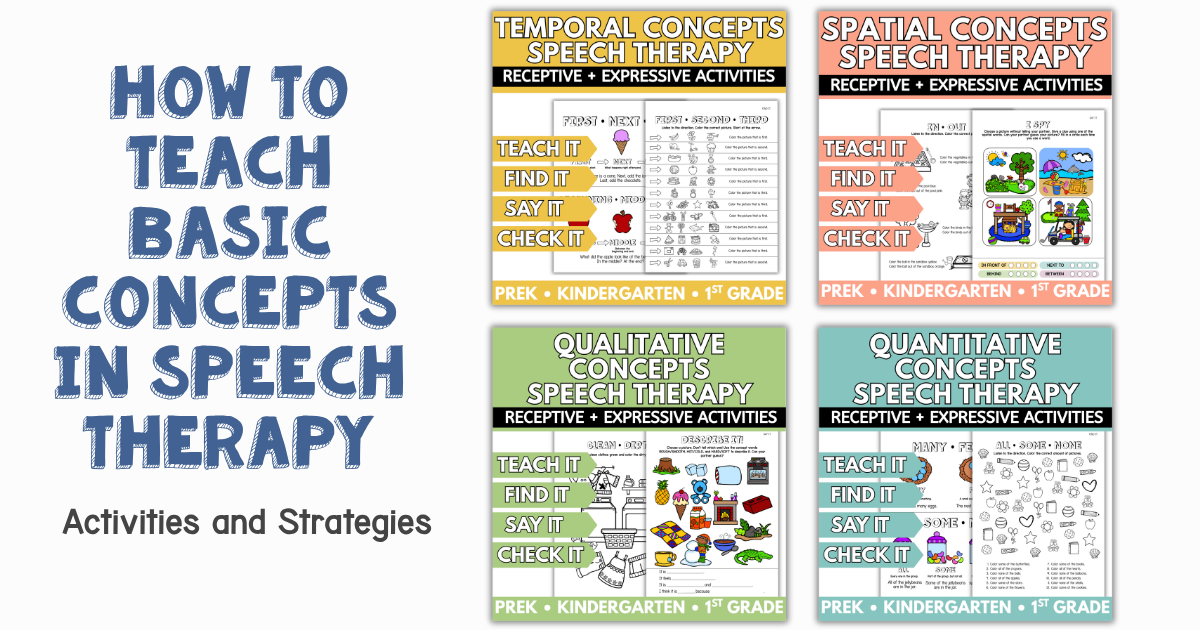
    And if you’re working with students who need support with sequencing, following directions, or understanding language concepts, you might also enjoy How to Teach Basic Concepts in Speech Therapy: Activities and Strategies. It’s full of ideas for building receptive and expressive language skills through structured, engaging activities.

  • Basic Concepts Speech Therapy: How to Teach Them Effectively

    Basic Concepts Speech Therapy: How to Teach Them Effectively

    Basic concepts are everywhere in a child’s day. We ask students to line up before recess, choose the biggest object, put their folder under their desk, or finish all of their work. These directions might seem simple, but for students with language difficulties, understanding the vocabulary can be challenging.

    As a school-based speech-language pathologist, I’ve worked with plenty of students who can follow familiar classroom routines but struggle when the language changes. A student might understand “Put your pencil away” but become confused when asked to “Put your pencil away after you finish the last problem.”

    That’s why teaching basic concepts in speech therapy is about more than memorizing vocabulary. Students need opportunities to understand, identify, use, and apply these concepts in meaningful situations.

    Here are some of my favorite ways to make that happen without adding hours to therapy planning.

    What Are Basic Concepts in Speech Therapy?

    Basic concepts are words that describe relationships between objects, people, quantities, time, and characteristics.

    These concepts are essential for understanding directions, participating in classroom activities, and communicating clearly.

    Some common categories include:

    • Spatial concepts: in, on, under, between, beside, behind
    • Temporal concepts: before, after, first, next, last, while
    • Quantitative concepts: more, less, all, none, most, few
    • Qualitative concepts: big, small, heavy, light, clean, dirty
    • Negation concepts: not, except, without

    Although students may recognize some of these words in familiar situations, understanding them across different contexts is often more difficult.

    For example, a student might understand before when talking about their daily schedule but struggle to follow a direction such as “Before you color the star, circle the triangle.”

    That difference matters when we’re planning therapy.

    1. Start With Direct Teaching

    One mistake I try to avoid is assuming students will learn basic concepts simply by hearing them during activities.

    Some students need explicit instruction before they’re ready to use a concept independently.

    When introducing a new word, I like to:

    • Explain the concept using student-friendly language.
    • Demonstrate it with familiar objects or pictures.
    • Show examples and nonexamples.
    • Give students opportunities to identify the concept.
    • Gradually move toward using the word independently.

    For example, when teaching between, I might place a pencil between two crayons, then move it beside the crayons and ask students to explain the difference.

    The goal is to make the meaning clear before expecting students to follow increasingly complex directions.

    Make Verbal Instruction Visual

    When teaching basic concepts, I don’t want students to rely on verbal explanations alone. I want them to see what the words mean.

    Visual supports can make abstract language more concrete, especially for students who have difficulty processing or remembering verbal information.

    For example, when introducing before and after, I use visuals that show the order of events. When teaching more and less, I use pictures that allow students to compare quantities. For qualitative concepts such as full and empty, I show the two concepts side by side so students can clearly see the difference.

    I also like to keep these visuals available throughout the activity. That way, students can refer back to them when following directions, answering questions, or formulating sentences.

    Here are a few examples of the visual supports I use when teaching basic concepts in speech therapy.

    Speech therapy visuals comparing quantitative concepts such as more, fewer, most, and least using illustrated objects.
    Picture supports for teaching qualitative concepts in speech therapy, showing fast and slow and heavy and light comparisons.
    Spatial concepts speech therapy visuals illustrating behind, in front of, next to, and between using colorful picture examples.

    Make time-related language easier to understand! These visuals help students see the relationships between concepts like before, after, first, next, and last before applying them to directions and everyday routines.

    Turn abstract quantity words into something students can see! Side-by-side visuals help students understand and compare concepts such as more, less, all, none, and few.

    Help students recognize and describe important characteristics! Clear picture comparisons make concepts like big/small, heavy/light, and clean/dirty easier to understand and use in meaningful sentences.

    Make location words easier to understand! These visuals help students see the relationships between objects while learning concepts like in, on, under, behind, beside, and between. Students can use these visual supports to build understanding, follow directions, and describe where objects are located.

    The visuals aren’t meant to replace verbal instruction. They help reinforce it. As students become more confident with a concept, I can gradually reduce the visual support and see whether they’re able to demonstrate understanding independently.

    2. Move From Receptive to Expressive Language

    Understanding a concept and using it independently are two different skills.

    A student might correctly point to the largest animal but struggle to explain which animal is largest or compare two objects using the word.

    I like to build both skills into therapy.

    Receptive practice: “Point to the cup that is empty.”

    Expressive practice: “Tell me how these two cups are different.”

    Once students are successful with familiar examples, I change the pictures, objects, and situations.

    This helps determine whether they truly understand the concept rather than relying on memorized responses.

    3. Use a Consistent Teaching Routine

    One of my favorite ways to organize basic concepts instruction is a simple four-step routine:

    TEACH IT → FIND IT → SAY IT → CHECK IT

    TEACH IT: Introduce the concept with clear explanations and examples.

    FIND IT: Have students identify the concept in pictures, objects, or situations.

    SAY IT: Encourage students to use the concept in sentences, descriptions, or explanations.

    CHECK IT: Use a quick probe to determine whether students can demonstrate the skill with less support.

    I use this approach in my Basic Concepts Speech Therapy Growing Bundle, which includes activities for temporal, spatial, quantitative, and qualitative concepts.

    Having a consistent routine makes it easier to plan sessions, differentiate activities, and monitor student progress.

    Basic concepts speech therapy teaching visuals comparing wet and dry and clean and dirty using picture examples.
    Clean and dirty laundry picture activity for identifying qualitative basic concepts in speech therapy.
    What Happened picture worksheet for practicing expressive language and describing changes using basic concepts.
    Qualitative concepts progress monitoring checklist for tracking student understanding and use of basic concepts in speech therapy.

    TEACH IT

    FIND IT

    SAY IT

    CHECK IT

    4. Make Basic Concepts Hands-On

    You don’t need elaborate materials to make basic concepts engaging.

    Some of my favorite activities use objects that are already in the speech room.

    Try using:

    • Blocks: Build towers that are taller, shorter, or the same height.
    • Toy animals: Place animals in front of, behind, or between objects.
    • Classroom supplies: Sort items by size, quantity, or characteristics.
    • Picture scenes: Identify objects that are empty, full, clean, dirty, or different.
    • Movement activities: Follow directions involving first, next, before, and after.

    Hands-on activities give students opportunities to see and experience the meaning of concepts rather than simply answering questions on a worksheet.

    They also make it easier to adjust the level of difficulty during mixed-group sessions.

    5. Practice Concepts in Following Directions

    Basic concepts are closely connected to students’ ability to follow classroom directions.

    Once students understand a target concept, I like to incorporate it into directions that gradually increase in complexity.

    For example, when working on temporal concepts:

    Level 1: “Touch the first picture.”

    Level 2: “Circle the star before you color the heart.”

    Level 3: “After you cross out the smallest animal, underline the picture that shows what happened first.”

    The goal isn’t simply to make directions longer. It’s to help students process the language accurately.

    If a student struggles, I consider whether the difficulty comes from the concept itself, sentence structure, working memory demands, or a combination of factors.

    6. Use Basic Concepts During Mixed-Group Therapy

    One of the biggest challenges of school-based speech therapy is planning for groups with different goals.

    Fortunately, basic concepts can fit naturally into activities targeting other language skills.

    For example, one picture scene can address several goals:

    • Basic concepts: Identify the object that is behind the tree.
    • Sentence formulation: Describe where the object is located.
    • Following directions: Circle the smallest object before coloring the largest.
    • Inferencing: Explain why an object might be wet or dirty.
    • Executive functioning: Plan the order of steps needed to complete a task.

    Using one activity across multiple goals keeps therapy manageable while still providing individualized practice.

    That’s exactly why I created my Following Directions Picture Scenes Growing Bundle. These low-prep activities make it easier to target multiple speech and language goals without juggling different materials for every student.

    Black-and-white classroom picture scene with one-step and two-step following directions for practicing basic concepts, spatial vocabulary, and language skills in speech therapy.

    Looking for even more ways to simplify your speech therapy planning? Check out my 10 Low-Prep Speech Therapy Activities for Busy School-Based SLPs for practical ideas that keep students engaged without adding hours to your prep time.

    7. Don’t Forget Generalization

    A student may demonstrate strong accuracy during structured speech therapy activities but continue struggling with similar language in the classroom.

    That’s why generalization matters.

    Try incorporating basic concepts into:

    • Classroom routines and schedules
    • Storybooks and read-alouds
    • Math and science vocabulary
    • Art projects and crafts
    • Daily conversations
    • Multi-step classroom directions

    For example, a student working on before and after might practice those concepts during speech therapy, then use them to describe the order of classroom activities.

    The more contexts students encounter, the more opportunities they have to develop flexible understanding.

    8. Monitor Progress Beyond Worksheet Accuracy

    When monitoring basic concepts, I want to know more than whether a student can answer familiar questions correctly.

    I also consider:

    • Can the student identify the concept with unfamiliar pictures?
    • Can they explain or demonstrate its meaning?
    • Can they use the concept in a sentence?
    • Can they follow directions containing the concept?
    • How much prompting or visual support do they need?

    A brief probe using unfamiliar examples can help identify whether a student is ready to move forward or needs additional instruction.

    It also provides useful information for adjusting therapy goals and documenting progress.

    Making Basic Concepts Therapy Easier to Plan

    Teaching basic concepts doesn’t have to mean creating an entirely new activity for every session.

    I find that a consistent routine, explicit instruction, hands-on practice, and opportunities for generalization make a meaningful difference.

    If you’re looking for ready-to-use materials, my Basic Concepts Speech Therapy Bundle includes resources targeting temporal, spatial, quantitative, and qualitative concepts using the TEACH IT → FIND IT → SAY IT → CHECK IT approach.

    The activities are designed to support receptive and expressive language, following directions, and progress monitoring while keeping preparation manageable.

    Whether you’re working with one student or a mixed group, the goal is the same: help students understand the language they encounter throughout their school day and use it with greater confidence.

  • 10 Low-Prep Speech Therapy Activities for Busy School-Based SLPs

    10 Low-Prep Speech Therapy Activities for Busy School-Based SLPs

    If you’re a school-based Speech-Language Pathologist, you know how quickly a busy therapy schedule can fill up. Between IEP meetings, progress monitoring, evaluations, and back-to-back speech sessions, finding time to plan engaging activities isn’t always easy.

    After 20 years of working as an SLP, I’ve learned that effective speech therapy doesn’t have to involve hours of preparation. Some of my favorite activities are simple, flexible, and easy to adapt for students working on different goals.

    Whether you’re targeting articulation, expressive and receptive language, or executive functioning skills, these 10 low-prep speech therapy activities can help you make the most of your therapy time without adding more work to your already full plate.

    10 Low-Prep Speech Therapy Activities to Try This Week

    1. Use Picture Scenes to Target Multiple Speech and Language Goals

    Picture scenes are one of my favorite tools for mixed speech therapy groups because students can work on completely different goals while using the same activity.

    One student might practice articulation by naming objects in the picture, while another works on following one- or two-step directions. Other students can describe what they see, answer WH questions, make inferences, or expand simple sentences.

    To make the activity even more interactive, have students draw or color objects as they follow directions. This adds a hands-on element without requiring a complicated setup.

    Low-prep tip: Keep a few seasonal picture scenes ready to go. You can use the same scene across multiple sessions by changing the questions, directions, or language targets.

    2. Build Language Skills with Would You Rather Questions

    Would You Rather questions are an easy way to get students talking while targeting a variety of speech and language goals. They’re especially helpful when you have students working at different language levels in the same group.

    Start with a simple question, such as, “Would you rather visit the beach or the mountains?” Then encourage students to explain their choices.

    Younger students can practice answering questions, using complete sentences, and giving simple reasons. Older students can work on comparing and contrasting, making predictions, explaining their opinions, and considering different perspectives.

    You can also incorporate articulation practice by having students use their target sounds when responding.

    Low-prep tip: Keep a collection of seasonal Would You Rather questions handy. Use them as warm-ups, conversation starters, or quick activities when you have a few extra minutes at the end of a session.

    3. Turn Articulation Practice into Simple, No-Prep Games

    Articulation practice doesn’t have to mean drilling flashcards for an entire speech therapy session. With a few simple activities, you can keep students engaged while still getting plenty of opportunities to practice their target sounds.

    One of my favorite strategies is to pair articulation practice with an easy game or printable activity. Students might color a section of a picture after practicing a set of words, move a game piece after producing their target sound, or complete part of a simple craft as they practice.

    For students who need more repetitions, try a quick challenge: say five target words before taking a turn. You can easily adjust the number of repetitions based on each student’s needs.

    Looking for more ways to keep students engaged without spending hours planning? Check out my 10 Favorite Speech Therapy Games That Target Multiple Goals for practical ideas to target articulation, language, and executive functioning in mixed groups.

    Low-prep tip: Choose articulation activities that can be used with multiple sounds and at different levels, from single words to sentences. This makes it much easier to plan for mixed groups without preparing a separate activity for every student.

    If your students enjoy hands-on articulation activities, my Never-Ending Articulation Books are another fun way to get repeated practice without relying on traditional flashcards. Students create an interactive folding book filled with target words they can practice during speech sessions and take home for additional practice.

    Never-Ending Articulation Books Growing Bundle featuring printable speech therapy crafts for R blends, S blends, and R sounds.

    4. Practice Executive Functioning with Everyday Problem-Solving Scenarios

    Executive functioning skills are an important part of many speech therapy sessions, especially when working with students who struggle with planning, flexible thinking, emotional regulation, and problem-solving.

    One of my favorite low-prep activities is presenting students with everyday situations and asking them to think through possible solutions.

    For example, you might ask, “You forgot your homework at home. What could you do?” or “Your friend wants to play a different game than you. How could you handle that?”

    Have students identify the problem, brainstorm two or three possible solutions, and discuss what might happen with each choice.

    For younger students, picture cards and simple scenarios can make these abstract skills more concrete. Older students can work through more complex situations involving friendships, classroom expectations, and decision-making.

    Low-prep tip: Use situations that are familiar to your students. Real-life scenarios make it easier to connect the skills practiced in speech therapy to situations students encounter throughout their school day.

    Looking for a ready-to-use way to practice these skills? My Think-It-Through Problem-Solving Flipbooks help students explore everyday problems, consider possible choices, and think through the outcomes.

    Think It Through problem-solving flipbooks for elementary speech therapy, featuring a four-step framework for making choices and solving social problems.

    5. Build Vocabulary with Quick Category Challenges

    Category activities are one of the easiest ways to target vocabulary, word relationships, and expressive language without spending time preparing materials.

    Start by naming a category, such as animals, foods, school supplies, or things you find outside. Have students take turns naming items that belong in that category.

    To increase the difficulty, ask students to explain why an item belongs, identify subcategories, or name something that doesn’t belong.

    For older elementary students, you can also incorporate Tier 2 vocabulary by asking students to identify similarities, differences, and relationships between words.

    One variation I enjoy is giving students a category and challenging them to name five items before time runs out. You can also reverse the activity by providing three related words and having students identify the category.

    Low-prep tip: Keep a short list of categories on your desk or use categories connected to classroom themes. This makes it easy to adjust the activity for different ages and language abilities.

    6. Use Sentence Expansion to Strengthen Expressive Language

    Sentence expansion is a simple activity that can make a big difference for students working on expressive language skills.

    Start with a basic sentence, such as “The dog runs.”

    Then encourage students to add details by answering questions such as Who? What? Where? When? Why? and How?

    For example:

    • The dog runs.
    • The brown dog runs.
    • The brown dog runs through the park.
    • The excited brown dog runs through the park to catch a ball.

    Students can practice adding descriptive vocabulary, using more complex sentence structures, and organizing their ideas into complete sentences.

    For younger students, pictures provide helpful visual support. Older students can work on combining sentences, adding conjunctions, and using more precise vocabulary.

    Low-prep tip: Use pictures from books, classroom materials, or seasonal scenes you already have available. One picture can provide multiple opportunities for sentence expansion across different language levels.

    7. Practice Following Directions with Draw-and-Color Activities

    Following directions activities don’t have to involve complicated materials or elaborate setups. Sometimes all you need is a piece of paper and a few crayons.

    Give students simple drawing or coloring directions, such as “Draw a circle at the top of your paper” or “Color the largest star blue.”

    As students become more successful, increase the complexity by incorporating spatial concepts, temporal concepts, and multistep directions.

    For example, “Before you color the flower, draw a butterfly next to it.”

    You can also include directions containing words such as unless, except, either, neither, and after for students who are ready for more challenging language.

    These activities provide opportunities to work on listening comprehension, working memory, attention, and understanding basic concepts.

    Low-prep tip: Use one drawing scene for an entire mixed group. Simply adjust the complexity of the directions based on each student’s goals.

    If you are looking for ready-to-use activities, my Following Directions Bundle includes engaging picture scenes that make it easy to target listening comprehension, basic concepts, and multistep directions. These activities are especially helpful for mixed speech therapy groups because you can adjust the directions to meet different students’ needs.

    Apple picking speech therapy picture scene with coloring and drawing activities for practicing one-step and two-step directions, language concepts, and IEP goals.

    Looking for more ways to build receptive and expressive language skills? Check out my How To Teach Basic Concepts in Speech Therapy article for practical strategies, visual supports, and hands-on activities that work well in mixed-group sessions.

    8. Strengthen Inferencing Skills with Mystery Clues

    Inferencing can be challenging for students because it requires them to combine information they hear or see with what they already know.

    A quick mystery clue activity is an engaging way to practice this skill without preparing an entire lesson.

    Start by describing an object, place, or situation without naming it.

    For example:

    “I’m thinking of something that you wear when it rains. It helps keep your clothes dry, and it usually has a hood.”

    Students use the clues to determine the answer and explain how they figured it out.

    You can also make the activity more challenging by giving clues about emotions, social situations, or events.

    For older students, ask them to identify which clues were most helpful and explain their reasoning.

    Low-prep tip: Use familiar classroom objects, seasonal vocabulary, or everyday situations. Encourage students to create their own mystery clues for classmates to solve.

    9. Use Simple Storytelling Activities to Build Narrative Language

    Storytelling is a wonderful way to target sequencing, sentence formulation, vocabulary, and overall language organization.

    One easy activity is to give students three words or pictures and challenge them to create a short story using all three.

    For example, provide the words dog, backpack, and playground.

    Students might create a story about a dog who finds a backpack at the playground.

    Younger students can focus on telling what happened first, next, and last. Older students can add story elements such as characters, setting, problem, feelings, actions, and resolution.

    You can also encourage students to retell their stories using transition words and complete sentences.

    Low-prep tip: Keep a collection of picture cards or familiar vocabulary words available. Students can choose three at random to create a different story each session.

    10. Build Flexible Thinking with Compare-and-Contrast Challenges

    Compare-and-contrast activities are a simple way to build vocabulary, reasoning, and higher-level language skills.

    Choose two familiar objects, activities, or situations and ask students to explain how they are alike and different.

    For example, compare a bicycle and a scooter.

    Students might identify that both have wheels and are used for transportation, but they differ in how they are ridden.

    You can also compare less concrete ideas, such as two school activities, different ways to solve a problem, or characters from a story.

    For students who need additional support, use pictures and sentence starters such as “Both ___ and ___” or “One difference is ___.”

    Older students can practice explaining more complex relationships and supporting their responses with specific details.

    Low-prep tip: Let students choose the two items to compare. Giving them some ownership often leads to more meaningful discussions and longer responses.

    Making Low-Prep Speech Therapy Work for You

    One thing I’ve learned throughout my years as an SLP is that successful therapy doesn’t require a different activity for every student or hours of preparation each week.

    Some of the most effective activities are the ones that can be used again and again, with small adjustments to meet different students’ needs.

    Whether you’re working on articulation, language, executive functioning, or social communication, having a collection of flexible activities can make your therapy sessions run more smoothly.

    At Raising Warriors SLP, I create practical speech therapy resources with busy SLPs in mind. My goal is to help you spend less time preparing materials and more time working with your students.

    If you’re looking for ready-to-use articulation, language, and executive functioning activities, I’d love for you to explore my resources!

    Explore speech therapy activities at Raising Warriors SLP on Teachers Pay Teachers!