If you’ve ever worked with a student who struggles to follow multistep directions, gets frustrated when plans change, or has difficulty organizing their thoughts, you’ve probably seen executive functioning challenges in action.
Executive functioning skills play an important role in how students learn, communicate, solve problems, and navigate everyday situations. And while these skills are often associated with classroom learning, they also overlap with many of the language and social communication goals we address in speech therapy.
The good news? You don’t need elaborate materials or an entirely separate lesson to incorporate executive functioning into your sessions!
In this post, I’m sharing 10 executive functioning activities for elementary speech therapy. These 10 executive functioning activities for speech therapy help elementary students strengthen planning, working memory, flexible thinking, and problem-solving skills without adding hours to your prep time.
Whether you have five minutes left in a session or want to build an entire lesson around executive functioning, you’ll find ideas you can put to use right away.
Why Use Executive Functioning Activities for Speech Therapy?
Executive functioning skills are the mental processes that help us manage our thoughts, actions, and emotions to accomplish goals. Think of them as the brain’s management system. These skills help students remember instructions, stay focused, adjust when something unexpected happens, and think through their choices before acting.
For elementary students, executive functioning skills are developing throughout the school years. Some students need additional support learning how to use these skills successfully in the classroom, during conversations, and in everyday routines.
Here are several executive functioning skills that frequently overlap with speech therapy goals:
- Working Memory: Holding information in mind long enough to use it, such as remembering the steps in a direction.
- Planning and Organization: Thinking ahead, identifying necessary steps, and putting ideas or actions in a logical order.
- Cognitive Flexibility: Adjusting to changes, considering different perspectives, and trying another strategy when something doesn’t work.
- Inhibitory Control: Pausing before responding, resisting distractions, and thinking before acting.
- Emotional Regulation: Recognizing emotions and using strategies to respond appropriately to challenging situations.
- Self-Monitoring: Recognizing when something isn’t working, checking your work, and making adjustments.
These skills don’t develop overnight, and students may demonstrate strengths in one area while needing support in another.
As speech-language pathologists, we can help students practice the language and communication skills that support executive functioning, particularly when difficulties affect following directions, organizing spoken language, problem-solving, and social interactions.
10 Executive Functioning Activities for Elementary Speech Therapy
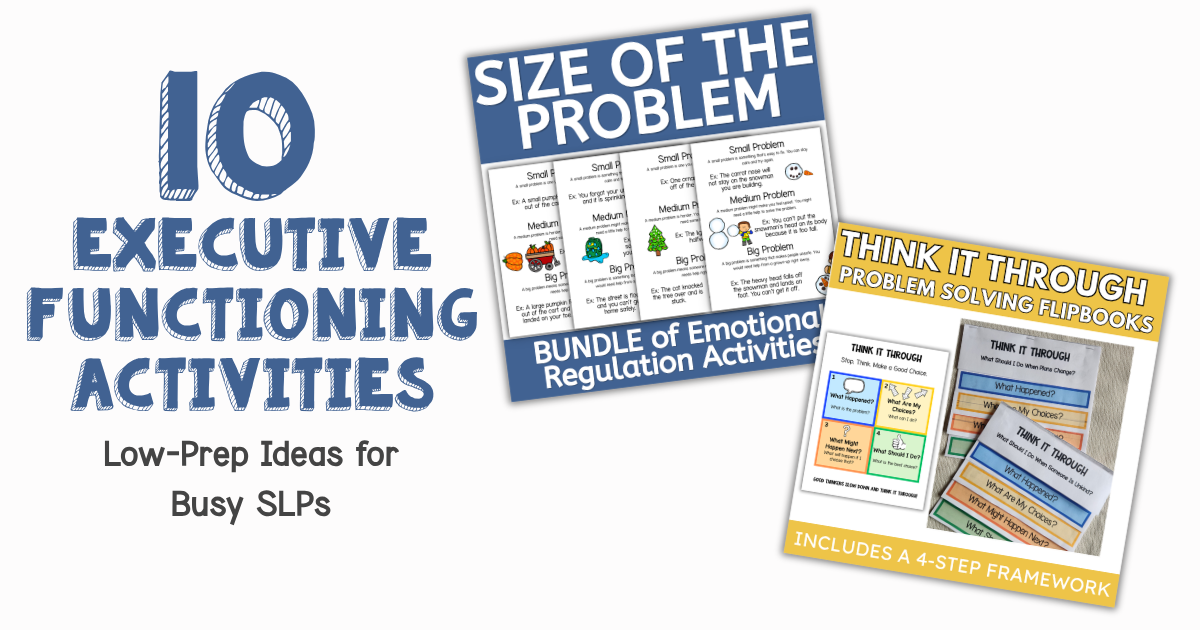
1. Use Problem-Solving Flipbooks to Practice Thinking Ahead
One of my favorite ways to target executive functioning during speech therapy is through everyday problem-solving scenarios. Students often know what they should do when a problem occurs, but actually thinking through their choices in the moment can be challenging.
Problem-solving flipbooks provide a visual, structured way to practice this important skill.
I like using a simple four-step approach:
- What happened? Identify the problem and explain the situation.
- What could you do? Brainstorm possible choices.
- What might happen next? Predict the outcome of each choice.
- What’s the best choice? Select a reasonable solution and explain why.
For younger students in kindergarten through second grade, start with familiar situations, such as someone taking a toy, forgetting a school supply, or not getting a turn during a game. Picture supports and simple choices can make the process more manageable.
For students in grades 3–5, introduce situations with multiple possible solutions. Encourage students to compare outcomes, consider another person’s perspective, and explain how they would adjust their plan if their first solution didn’t work.
Executive functioning skills targeted: Planning, cognitive flexibility, inhibitory control, and self-monitoring.
Speech therapy connections: Inferencing, predicting, sequencing, expressive language, and social communication.
Low-prep tip: Keep a few problem-solving scenarios ready for the last five minutes of a session. Students can talk through the steps without needing to complete an entire worksheet.
I created my Think It Through Problem-Solving Flipbooks to give students a consistent visual routine for working through everyday challenges. The same four questions can also be practiced during classroom situations, read-alouds, or conversations about real-life problems.

2. Practice Planning and Sequencing with Everyday Missions
Planning and organization can be challenging for elementary students, especially when a task involves several steps. Some students know what they want to accomplish but have difficulty figuring out where to begin, what materials they’ll need, or what order makes the most sense.
One simple way to practice these skills in speech therapy is by giving students an everyday mission to complete.
Try scenarios such as:
- You’re having a birthday party. What do you need to do to get ready?
- Your class is going on a field trip. What should you pack?
- You want to make a sandwich. What materials and steps do you need?
- You’re planning a lemonade stand. What needs to happen before you can open?
- Your family is going on a picnic. How will you get everything ready?
Ask students to identify their goal, gather the necessary materials, and organize the steps in a logical order.
Then add a challenge! What if it starts raining during the picnic? What if you forget something important? What if you don’t have enough time to finish everything?
These unexpected changes encourage students to evaluate their original plan and think about possible adjustments.
For K–2 students: Use picture cards or drawings to represent three or four steps. Have students arrange the pictures in order and explain what happens first, next, and last.
For grades 3–5: Encourage students to create their own plans, estimate how much time each step might take, prioritize important tasks, and identify possible obstacles.
Executive functioning skills targeted: Planning, organization, cognitive flexibility, time management, and self-monitoring.
Speech therapy connections: Sequencing, narrative organization, temporal concepts, expressive language, and problem-solving.
Low-prep tip: You don’t need special materials! Write an everyday mission on a sticky note or whiteboard and have students talk through their plan. For mixed groups, one student can sequence the steps while another explains the reasoning behind the plan.
To make the activity more challenging, ask students to explain why they chose a particular order or what they would do differently next time. This encourages students to reflect on their thinking rather than simply completing the task.
3. Strengthen Flexible Thinking with “What If?” Scenarios
Flexible thinking is an important executive functioning skill that helps students adjust when something doesn’t go as expected. Whether a game changes, a preferred activity is unavailable, or a classmate has a different idea, students benefit from practicing how to consider alternatives.
One easy way to build cognitive flexibility during speech therapy is through “What If?” scenarios.
Present a familiar situation, then introduce an unexpected change.
Try these examples:
- You planned to play outside, but it starts raining. What could you do instead?
- Your favorite game is missing a piece. How could you still play?
- Your group wants to play a different game than you do. What are some options?
- You forgot the supplies you need for a project. What’s another way to complete it?
- You practiced a presentation, but now you have to present first. How could you adjust?
Challenge students to come up with at least two possible solutions. Then discuss which choices might work best and why.
For K–2 students: Start with two visual choices and model flexible-thinking language such as “I could try…” or “Another idea is…”
For grades 3–5: Ask students to generate multiple solutions independently, compare possible outcomes, and explain how different people might respond to the same situation.
Executive functioning skills targeted: Cognitive flexibility, planning, emotional regulation, and self-monitoring.
Speech therapy connections: Problem-solving, perspective-taking, predicting, expressive language, and social communication.
Low-prep tip: Turn this into a quick group challenge! Give students 30 seconds to brainstorm as many reasonable solutions as they can. Then discuss how different ideas might work in different situations.
I also like to remind students that flexible thinking doesn’t mean they always have to agree with others or give up their preferences. It’s about recognizing that there may be more than one way to approach a situation and learning how to communicate and adapt when needed.
4. Match the Size of the Problem to the Size of the Reaction
Helping students recognize the difference between a small problem and a big problem is a practical way to incorporate emotional regulation, flexible thinking, and problem-solving into speech therapy.
Start by presenting familiar situations and asking students to consider how serious each problem is. For example:
- Your pencil breaks during class.
- Someone gets to be first in line instead of you.
- You forget your homework at home.
- A classmate accidentally bumps into you.
- Someone gets hurt on the playground.
Have students sort the situations into small, medium, and big problems. Then discuss what an appropriate response might look and sound like.
The important part isn’t just sorting the problems correctly. It’s helping students understand that different situations may require different responses, and that two people might experience the same situation differently.
For students in K–2, use picture cards, emotion visuals, and simple questions such as, “What could you do?” or “Who could help?”
For students in grades 3–5, introduce more complicated scenarios. Ask students to consider how their initial reaction might affect the situation, identify coping strategies, and discuss what they could do if their first strategy doesn’t help.
Executive functioning skills targeted: Emotional regulation, inhibitory control, cognitive flexibility, and self-monitoring.
Speech therapy connections: Emotion vocabulary, perspective-taking, inferencing, explaining choices, and social communication.
Low-prep tip: Use situations that naturally come up during games or group activities. If a student doesn’t get the turn they wanted or a game doesn’t go as planned, you have an opportunity to model flexible thinking and appropriate responses.
I use this approach in my Size of the Problem and Reaction Size activities, which include sorting mats, problem scenarios, and visual supports to help students talk through their reactions.
One important reminder: The goal isn’t to tell students that their feelings are too big or wrong. Instead, we’re helping them recognize their emotions, consider the situation, and choose responses that are safe, respectful, and helpful.

5. Strengthen Working Memory with Quick, No-Prep Games
Working memory helps students hold information in mind while using or manipulating it. It’s an important skill for following directions, participating in conversations, organizing sentences, and completing classroom tasks.
The great thing about working memory activities is that you don’t need elaborate materials. Some of my favorite activities can be completed with nothing more than a few words, pictures, or objects already in your speech room.
Try these three quick working memory games:
1. Remember and Repeat
Say three related words, such as “apple, banana, orange.” Ask students to repeat them in the same order. Gradually increase the number of words or add a short delay before they respond.
For an added language challenge, have students identify the category or use the words in a sentence after recalling them.
2. What’s Missing?
Place four or five familiar objects on the table. Give students time to look at them, then have them close their eyes while you remove one object.
Ask, “What’s missing?”
To increase the challenge, remove two objects or ask students to describe where the missing objects were located.
3. Listen, Remember, and Organize
Read a short list of words, such as “dog, apple, cat, banana.” Ask students to remember the words and then organize them into categories.
This activity challenges students to hold information in mind while also thinking about how the words are related.
For K–2 students: Start with two or three familiar items and provide visual supports when needed. Teach strategies such as repeating information aloud, grouping related items, or creating a mental picture.
For grades 3–5: Increase the amount of information, introduce short delays, or ask students to reorganize information according to specific rules.
Looking for more ways to practice executive functioning skills through play? Explore my 10 Speech Therapy Games That Target Multiple Goals for ideas that incorporate planning, flexible thinking, problem-solving, and emotional regulation.
Executive functioning skills targeted: Working memory, attention, and self-monitoring.
Speech therapy connections: Vocabulary, categorization, auditory comprehension, word retrieval, and expressive language.
Low-prep tip: Use vocabulary words or articulation targets students are already practicing. This allows you to incorporate a working memory challenge without abandoning their primary speech or language goals.
Remember that the goal isn’t simply to make the task harder. Pay attention to which strategies help students succeed, and encourage them to recognize when they need to repeat, organize, or write down information. These strategies can be especially valuable when applied to classroom tasks.
6. Practice Impulse Control with Stop-and-Think Games
Games are a natural way to practice inhibitory control, an executive functioning skill that helps students pause before acting, resist distractions, and think about their responses.
One of my favorite ways to target this skill is by adding a simple “stop and think” challenge to familiar speech therapy activities.
Try these three easy games:
1. Do the Opposite
Give students a simple direction, but ask them to do the opposite action. For example, when you say “stand,” they sit. When you say “hands up,” they put their hands down.
Start with two familiar actions before introducing additional rules.
2. Wait for the Magic Word
Give students directions, but explain that they should only respond when the direction begins with a specific word, such as “Ready.”
For example, “Ready, touch your nose” means students should respond, while “Touch your ears” means they should wait.
3. Think Before You Answer
Ask students familiar questions, but introduce a short waiting period before they respond. Students can silently think of their answers, then respond when given a signal.
For an additional language challenge, ask students to explain their answers using complete sentences.
For K–2 students: Use simple directions, visual reminders, and predictable rules. Model what it looks like to pause and listen before responding.
For grades 3–5: Introduce changing rules, more complex directions, or situations that require students to explain why they chose a particular response.
Executive functioning skills targeted: Inhibitory control, attention, working memory, and cognitive flexibility.
Speech therapy connections: Following directions, auditory comprehension, expressive language, and conversational turn-taking.
Low-prep tip: Add a stop-and-think rule to a game you’re already using. Students can practice waiting, listening, and checking the directions while continuing to work on their individual speech or language goals.
Remember that students may respond impulsively for different reasons, including difficulty understanding the directions. Keep the language manageable so you’re practicing the intended skill rather than making the activity unnecessarily confusing.
The goal isn’t to make students respond more slowly all the time. It’s to help them recognize situations when pausing, listening, and thinking before acting can be useful.
7. Build Working Memory with Following Directions Challenges
Following directions is a natural way to incorporate working memory into speech therapy. Students need to listen, understand the language, hold information in mind, and remember what to do next.
One of my favorite ways to practice these skills is with picture scenes. Students can follow directions by drawing, coloring, or adding objects to a scene, making the activity interactive without requiring a lot of preparation.
Start with simple directions such as:
- “Color the dog brown.”
- “Draw a ball next to the tree.”
- “Circle the bird, then color the flower yellow.”
Once students are successful, increase the working memory demands by adding more steps or requiring students to wait briefly before responding.
For example, show students a picture scene and say, “Draw a sun above the house, put three flowers beside the fence, and color the door blue.”
Before they begin, ask students to repeat the directions or explain their plan. Then have them complete the task and check their work.
For K–2 students: Begin with one- and two-step directions using familiar vocabulary. Provide visual supports, repeat directions when appropriate, and explicitly teach strategies such as repeating information aloud or using fingers to remember steps.
For grades 3–5: Incorporate temporal concepts, conditional directions, and multiple details. Encourage students to identify the most important information, mentally rehearse the steps, and independently check their completed work.
Executive functioning skills targeted: Working memory, sustained attention, planning, and self-monitoring.
Speech therapy connections: Receptive language, basic concepts, auditory comprehension, sequencing, and following directions.
Low-prep tip: Use the same picture scene with your entire group! One student might follow two-step directions while another works on conditional directions or explaining the sequence of actions.
I love using following directions picture scenes because they allow students to practice language and executive functioning skills together. My Following Directions Picture Scenes Growing Bundle includes themed scenes that can be adapted for different students and therapy goals.
Remember that difficulty following directions doesn’t always indicate a working memory weakness. Vocabulary knowledge, language comprehension, attention, and task familiarity can also affect performance. Adjust the language demands and memory demands separately when possible.

8. Build Self-Monitoring Skills with Check-and-Fix Challenges
Self-monitoring is an important executive functioning skill that helps students recognize when something isn’t working, evaluate their performance, and make adjustments.
In speech therapy, we use self-monitoring all the time! Students might listen for their target speech sound, check whether they included important details in a sentence, or notice when a listener doesn’t understand their message.
One simple way to practice this skill is through a “Check and Fix” challenge.
Give students a short task with an intentional mistake and ask them to identify what needs to be corrected.
Try these three activities:
1. Silly Sentence Detective
Say or write a sentence with an error, such as “Yesterday, the boy goed to the park.”
Ask students to identify the mistake, correct it, and explain how they knew something wasn’t right.
2. Direction Detective
Show students a completed picture scene that doesn’t match the directions.
For example, say, “The directions were to draw three stars above the house and color the door red.”
If the picture has two stars and a blue door, students must identify what needs to be fixed.
3. My Own Work Check
After completing a speech or language activity, have students pause and review their work using three questions:
- Did I follow the directions?
- Did I include everything I needed?
- Is there anything I want to change or improve?
For K–2 students: Use simple pictures, short sentences, and visual checklists. Model how to identify one mistake and make a correction.
For grades 3–5: Introduce tasks with multiple errors or ask students to independently develop a checklist before beginning an activity.
Executive functioning skills targeted: Self-monitoring, attention, planning, and cognitive flexibility.
Speech therapy connections: Speech sound self-monitoring, grammar, sentence formulation, following directions, and narrative organization.
Low-prep tip: Build a quick self-check into activities you’re already doing. Before students finish, ask, “How do you know you completed the task correctly?” or “What could you improve?”
One important distinction: Finding mistakes in someone else’s work is often easier than recognizing errors in your own. Gradually move from identifying obvious mistakes in prepared examples to checking real work and communication attempts.
The goal is to help students become more independent in recognizing when they need to pause, check their work, and make adjustments—not to expect perfection on every attempt.
9. Practice Organization and Prioritizing with ‘What Comes First?’ Challenges
Organization and prioritizing help students determine what needs to be done, decide which tasks are most important, and manage their responsibilities.
For elementary students, these skills come into play throughout the school day. From getting ready for class to completing assignments and managing materials, students are constantly making decisions about what to do first.
One easy way to practice these skills in speech therapy is with a “What Comes First?” challenge.
Present students with a situation and several tasks that need to be completed. Ask them to decide which tasks should happen first, which can wait, and why.
Try these everyday scenarios:
1. Getting Ready for School
You need to eat breakfast, pack your backpack, brush your teeth, and put on your shoes. What should you do first? Does everything need to happen in a specific order?
2. The Classroom Cleanup Challenge
There are books on the floor, markers without caps, papers scattered across a table, and chairs that need to be pushed in. You only have two minutes before leaving. What should you take care of first?
3. The Homework Challenge
You have a spelling assignment due tomorrow, a book report due next week, and a permission slip that needs to be signed tonight. How would you decide what to work on first?
For K–2 students: Present three or four tasks using pictures or simple verbal descriptions. Have students sort the tasks into “Do Now” and “Do Later” categories.
For grades 3–5: Introduce deadlines, time limits, and competing priorities. Ask students to explain their reasoning and consider how their plans might change if something unexpected happens.
Executive functioning skills targeted: Organization, prioritizing, planning, time management, and cognitive flexibility.
Speech therapy connections: Sequencing, temporal vocabulary, explaining reasoning, problem-solving, and expressive language.
Low-prep tip: Write three tasks on a whiteboard and ask students to rank them in order of importance. Encourage students to explain their choices using words such as first, before, after, because, and unless.
One of the most valuable parts of this activity is helping students recognize that there isn’t always one correct order. Sometimes the best choice depends on the deadline, available time, or importance of the task.
By discussing their reasoning, students practice organizing their thoughts while learning how to make thoughtful decisions about everyday responsibilities.
10. Build Executive Functioning Skills with Themed Speech and Language Challenges
One of my favorite ways to incorporate executive functioning into speech therapy is by using themed challenges that combine language, problem-solving, and higher-level thinking.
Instead of planning an entirely separate executive functioning lesson, I love finding ways to build these skills into activities students are already completing.
That’s one reason I include executive functioning components in my seasonal speech and language bundles!
Students might be challenged to plan an event, solve an unexpected problem, remember important information, consider different choices, or adjust their thinking when something doesn’t go as expected.
The activities give students opportunities to practice executive functioning while also working on familiar speech and language goals.
How can you use themed challenges in speech therapy?
Start by choosing a challenge that fits your students’ communication goals.
For younger elementary students, provide visual supports, model possible solutions, and encourage students to explain their choices using simple sentences.
For older elementary students, increase the language demands by asking them to compare possible solutions, predict outcomes, justify decisions, or explain how they would change their approach.
Executive functioning skills targeted: Planning, working memory, cognitive flexibility, inhibitory control, and self-monitoring, depending on the activity.
Speech therapy connections: Inferencing, problem-solving, following directions, expressive language, sequencing, and social communication.
Mixed-group tip: Use one challenge with multiple students, but adjust what you’re asking each student to do. One student might identify the problem, another could explain a possible solution, and another might predict what could happen next.
Want ready-to-use executive functioning challenges?
I incorporate executive functioning activities into my seasonal Speech and Language Bundles as well as my Old Lady Book Companions at Raising Warriors SLP. These resources are designed to help busy SLPs target multiple communication skills while keeping students engaged in meaningful activities.
It’s a practical way to incorporate executive functioning without adding another completely separate activity to your therapy planning!


These examples come directly from my 4th of July Speech/Language Bundle.
How to Target Executive Functioning in Mixed Speech Therapy Groups
One of the biggest challenges for school-based SLPs is finding activities that work for students with different speech and language goals. The good news is that executive functioning activities can often be incorporated into what you’re already doing!
For example, imagine your group is completing a problem-solving challenge together.
One student might practice producing their target articulation sound while explaining a solution. Another might work on using complete sentences to describe the problem. A third student might focus on making predictions, explaining their reasoning, or considering another person’s perspective.
Everyone participates in the same activity, but each student is working toward an individualized communication goal.
A few tips for making mixed groups successful:
- Choose one shared activity. Select a game, picture scene, or problem-solving challenge that allows students to participate at different levels.
- Adjust the language demands. Some students may need picture choices or sentence starters, while others can explain their thinking independently.
- Build in opportunities for discussion. Ask students to explain their choices, consider alternatives, and reflect on their strategies.
- Keep individual goals in mind. Executive functioning challenges can complement speech and language therapy without replacing students’ specific treatment targets.
You don’t need to address every executive functioning skill in every session. Sometimes a simple question like “What’s your plan?” or “What could you try differently?” is enough to encourage students to think more intentionally about their approach.
The goal is to make therapy meaningful, manageable, and relevant to the communication skills students use throughout their school day.
Helping Students Use Executive Functioning Skills Beyond the Speech Room
Practicing executive functioning skills during speech therapy is a great starting point, but the ultimate goal is helping students use those strategies in everyday situations.
A student might successfully explain how to solve a problem during a structured activity but still struggle to use that strategy when something unexpected happens in the classroom or on the playground.
That’s why I believe it’s important to make connections between our therapy activities and real-life situations.
Here are a few simple ways to encourage generalization:
- Use consistent language. Phrases such as “What’s your plan?”, “What could you try instead?”, and “How can you check your work?” can be used during therapy and throughout the school day.
- Connect activities to classroom routines. If students practice planning during a speech therapy challenge, discuss how that same strategy could help them organize materials or complete an assignment.
- Collaborate with teachers. Share a simple visual, strategy, or question that classroom staff can reinforce during everyday activities.
- Encourage students to reflect. After completing a task, ask what strategy helped them succeed and when they might use it again.
- Practice with real situations. When appropriate, incorporate challenges students are actually experiencing rather than relying exclusively on hypothetical scenarios.
For younger elementary students, visual reminders and adult modeling can help make these strategies more concrete.
Older elementary students may benefit from identifying which strategies work best for them, discussing when to use those strategies, and reflecting on their effectiveness.
It’s also important to remember that executive functioning skills don’t develop at the same pace for every student. Some students will need ongoing visual supports, repeated practice, and assistance using strategies across different environments.
The goal isn’t simply for students to complete an executive functioning activity successfully. It’s to help them recognize and use strategies that support their communication, learning, and independence in meaningful situations.
And as school-based SLPs, we can support that process by connecting executive functioning strategies to the language and communication skills we’re already addressing.
Making Executive Functioning Practice Meaningful and Manageable
Incorporating executive functioning activities into elementary speech therapy doesn’t have to mean adding more planning to your already busy schedule.
Many of the activities you’re already using—following directions, sequencing, problem-solving, picture scenes, and language games—provide opportunities to practice skills such as working memory, planning, flexible thinking, and self-monitoring.
The key is being intentional about the strategies you’re teaching and helping students recognize when those strategies might be useful outside the speech room.
Whether you’re working with kindergarten students who are just beginning to think through everyday problems or fifth graders who are learning to organize their thoughts and consider multiple solutions, small opportunities for practice can make therapy more meaningful.
Looking for low-prep speech therapy activities that incorporate executive functioning?
At Raising Warriors SLP, I create practical speech and language resources designed for busy SLPs and mixed therapy groups. Many of my seasonal speech and language bundles include executive functioning challenges alongside activities targeting expressive language, receptive language, following directions, and problem-solving.
My goal is simple: to help you spend less time preparing materials and more time helping your students grow.
Explore my speech therapy resources on Teachers Pay Teachers, and be sure to check out my other blog posts for more practical therapy ideas!
If you’re looking for more ways to make therapy planning easier, check out my 10 Low-Prep Speech Therapy Activities for Busy School-Based SLPs for practical ideas you can use with minimal preparation.
And if you’re working with students who need support with sequencing, following directions, or understanding language concepts, you might also enjoy How to Teach Basic Concepts in Speech Therapy: Activities and Strategies. It’s full of ideas for building receptive and expressive language skills through structured, engaging activities.
Leave a Reply